Some InterJets included an ISDN interface for WAN access. First-generation InterJets could use an external ISDN terminal adapter on the serial port (Whistle's connection FAQ names the 3Com Impact IQ and the BitSurfr), or an internal ISA card, which WhistleWare calls the "internal ISDN port". WhistleWare 3.0.3's notes call it "the InterJet's internal ISDN adapter (available on some InterJet models)", and the Models page lists one for the 140. In the Netherlands, KPN's 1998 sales papers offer "De Whistle InterJet 140" with ISDN at 64 or 128 kbps. The InterJet II has ISDN-U built in.
The internal card is a Digi DataFire, which Digi made in two versions because ISDN reaches the customer differently on each side of the Atlantic. In North America the telephone company delivers the two-wire U interface and the customer supplies the NT1, the box that converts it; a U card has the NT1 built in. In Europe the telephone company supplies the NT1, and the customer plugs into its four-wire S/T interface. One WhistleWare driver runs either card.
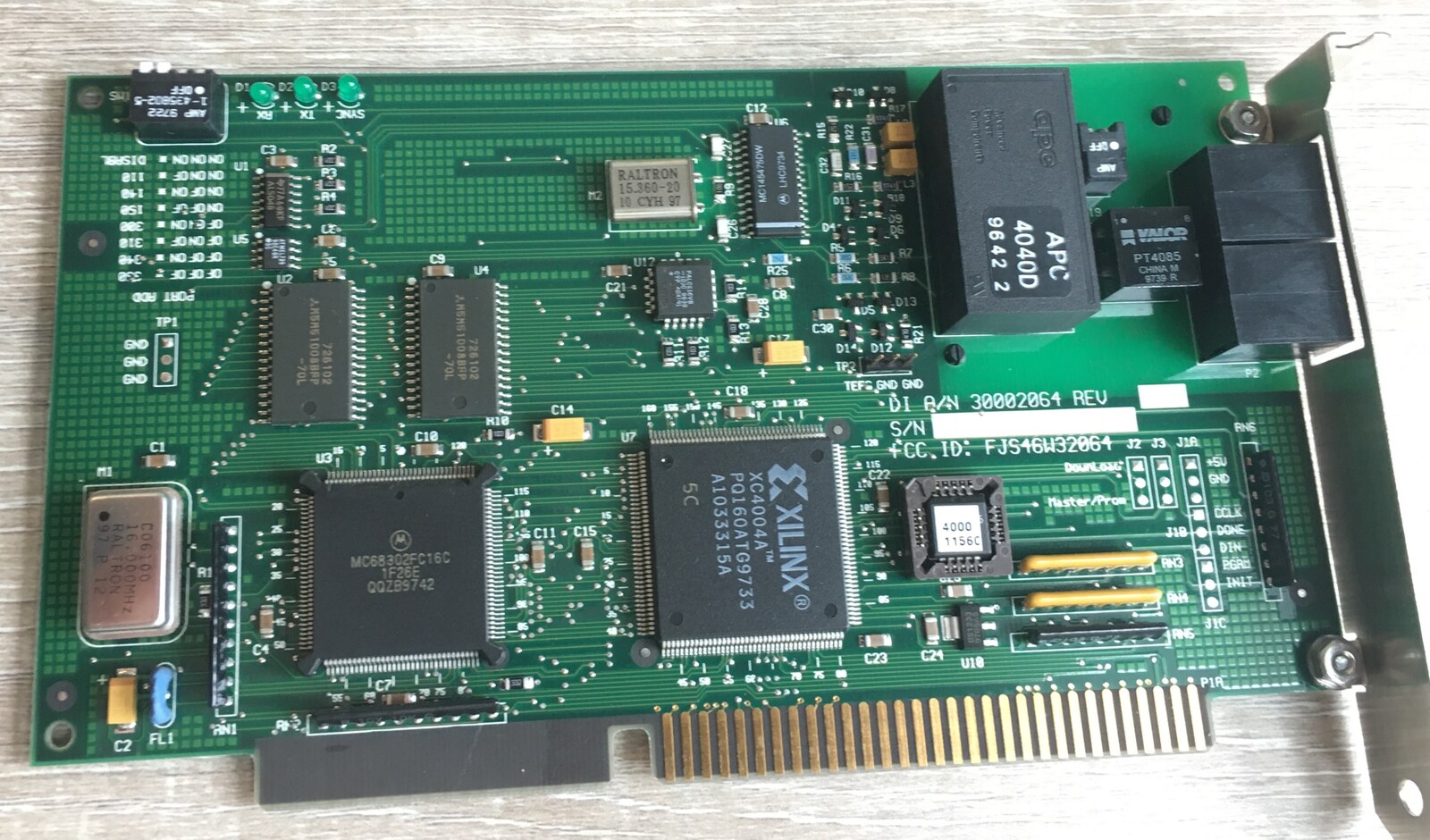
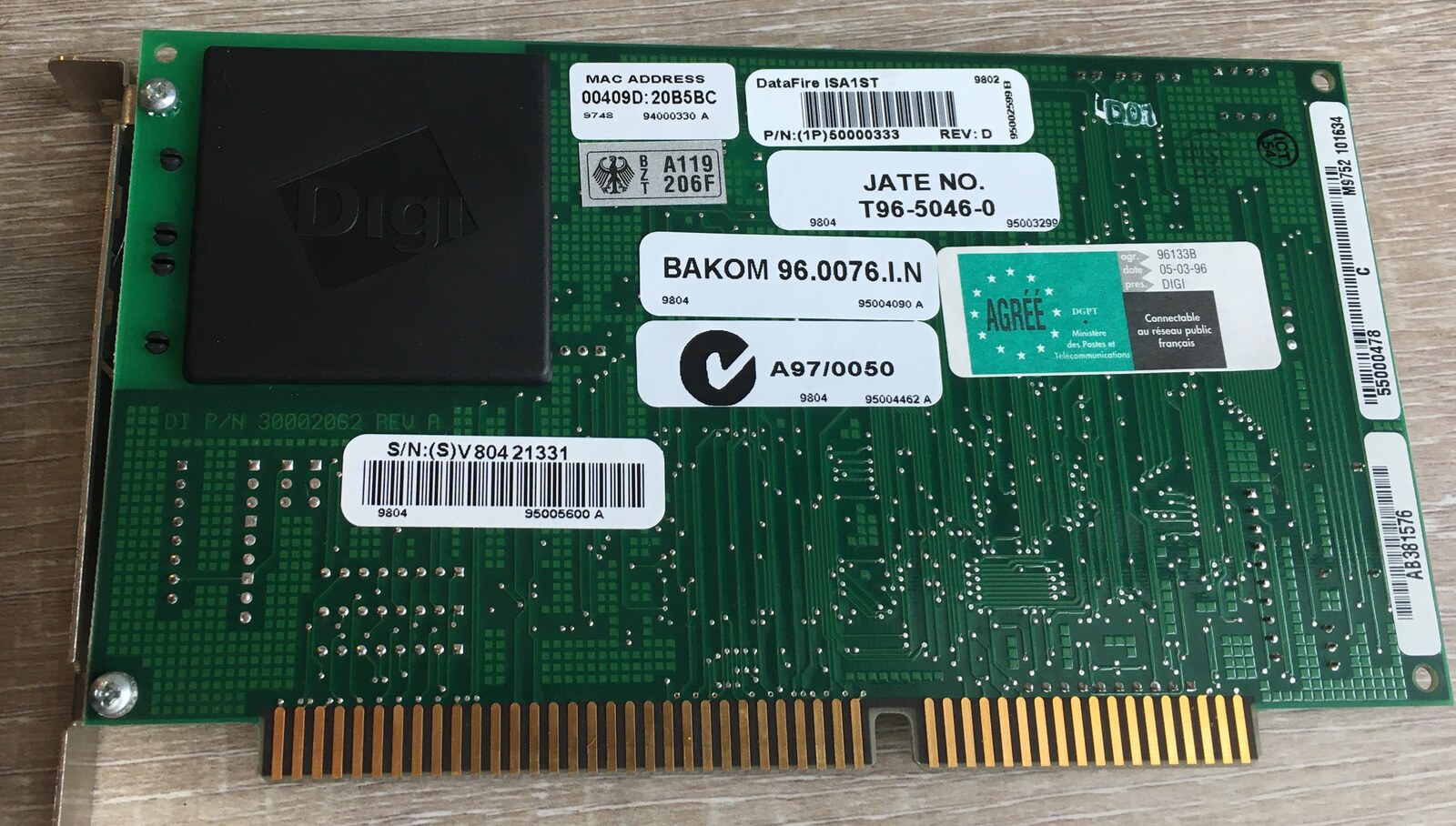
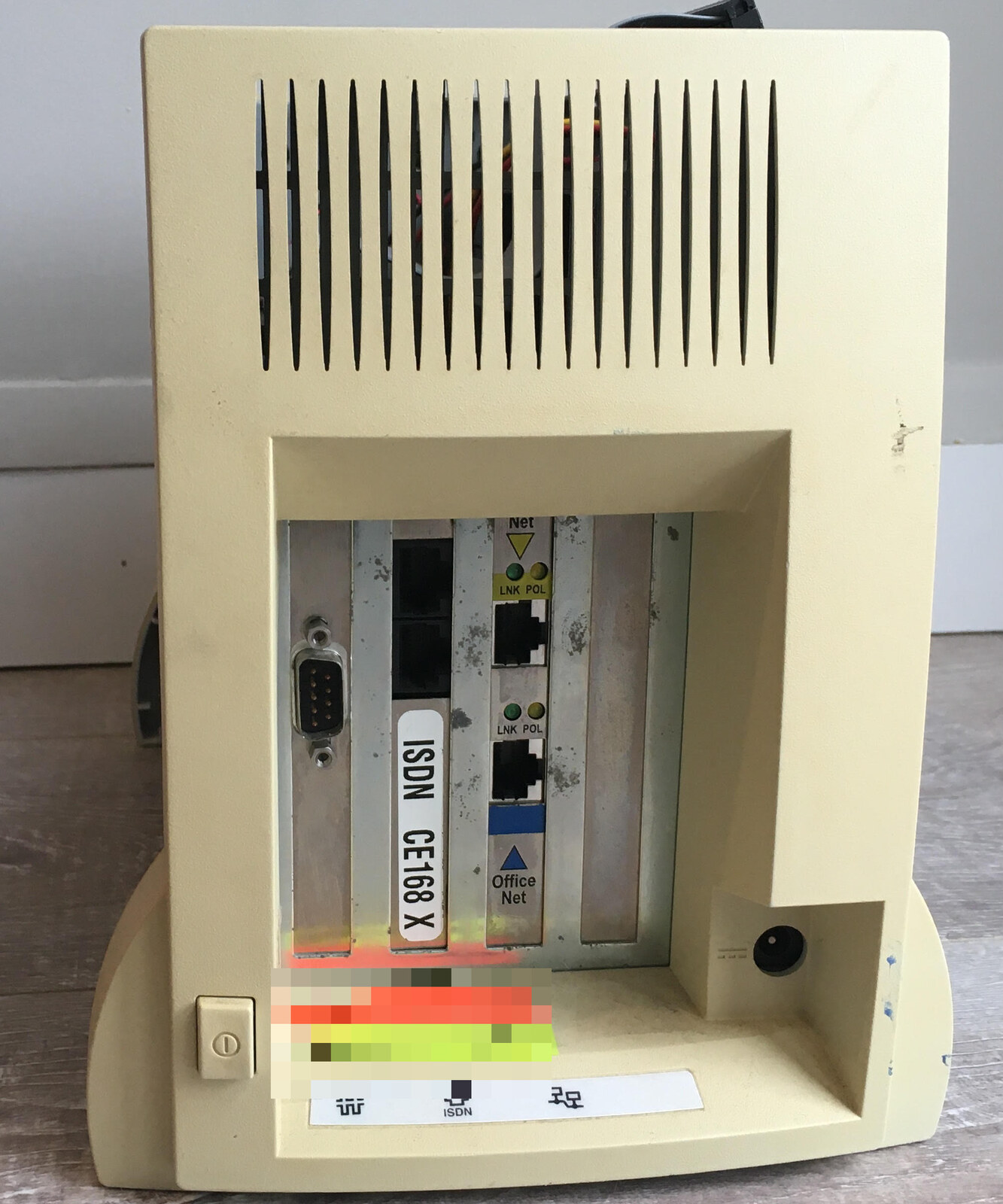
This section is about one internal card: a Digi DataFire ISA1ST, still in an InterJet 200 in the Netherlands, beside its dual-Ethernet card, and still configured for its ISP. Its owner, The Dutch Whistler, sent the photos and logs below.
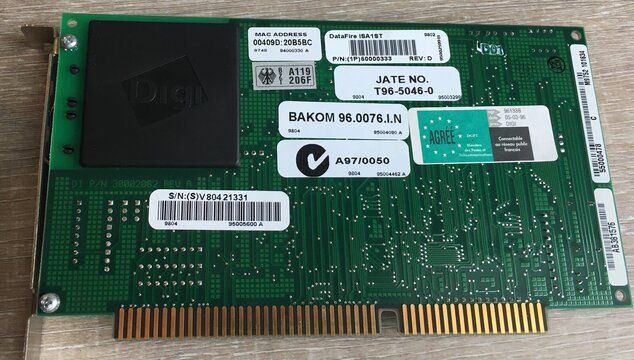
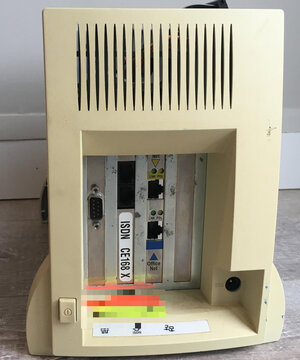
| Product | Digi DataFire ISA1ST, P/N 50000333, rev D (back label) |
| Maker | DigiBoard, later Digi International; Digi logo on the back |
| FCC ID | FJS46W32064 (silkscreened on the front) |
| Interface | ISDN Basic Rate, S/T; two RJ-45 jacks |
| Bus | 16-bit ISA |
| I/O address | 0x110-0x117, set by a four-position DIP switch (silkscreen choices: disabled, 110, 140, 150, 300, 310, 340, 350). No interrupt |
| Board numbers | DI A/N 30002064 (front), DI P/N 30002062 rev A (back), 55000478 rev C (edge label) |
| Label dates | 9748 to 9804, which reads as late 1997 to early 1998 |
| LEDs | RX, TX, SYNC |
Main parts, as marked:
| Ref | Part | Description |
|---|---|---|
| U3 | Motorola MC68302FC16C | 16 MHz communications processor |
| U6 | Motorola MC145475DW | ISDN S/T transceiver |
| U7 | Xilinx XC4004A, PQ160 | FPGA |
| U2, U4 | Mitsubishi M5M51008BFP-70L | 128K x 8 SRAM, two |
| socket | PLCC labeled "4000 1156C" | beside the Xilinx configuration header (J1: CCLK, DONE, DIN, PROG, INIT); probably the FPGA's configuration PROM |
| M1 | Raltron CO6100, 16.000 MHz | oscillator for the 68302 |
| M2 | Raltron 15.360 MHz | crystal beside the transceiver |
| APC 4040D; Valor PT4085 | line interface module and transformer, beside the jacks |
Approval labels:
These are the card's own approvals as Digi sold it. Our Japanese references do not show that InterJets were sold with ISDN in Japan.
On WhistleWare 3.2.1p16, the kernel finds the card at boot:
df0 at 0x110-0x117 flags 0x6 on isa
df0: 16.000MHz 68302, 145475 S/T BRI interface
The connection runs as:
/whistle/bin/mpd -kbdr /data/net/ports/Isd0 -p /data/net/ports/Isd0/mpd.pid -l Isd0
/data/net/ports/Isd0/mpd.links, the first of its two links (the second, Isd0b, is the same with lterm 1; the dial number is removed):
Isd0a:
        set link type df
        set df node "df0:"
        set df switch 5
        set df telno (removed)
        set link max-redial 0
        set link bandwidth 64000
        set link latency 5000
        set df dirnos "" ""
        set df spids "" ""
        set df lterm 0
From mpd.conf (login and addresses removed):
Isd0:
        new -i tun2 Isd0 Isd0a Isd0b
        set iface disable on-demand
        set iface route default
        set bundle enable multilink
        set bundle yes shortseq
        set bundle disable bw-manage
        link Isd0a
        set link yes acfcomp
        set link yes protocomp
        set link disable pap chap
        set link accept pap chap
        link Isd0b
        ...
        set ipcp yes vjcomp
        open
switch 5 is NET3 (Euro-ISDN; see the switch table), which is also what KPN's demonstration guide tells the installer to choose. European switch types take no directory numbers or SPIDs, which is why dirnos and spids are empty here.
What we know about the North American version is sparse. No InterJet with a U card has been examined here, and no photo or boot log of one has turned up.
Whistle's df driver handles both versions. It polls the card from the clock rather than using an interrupt, which is why the probe has no IRQ; in flags 0x6, 0x2 selects polling and 0x4 appears to select a faster poll. It recognizes two S/T transceivers (145474, 145475) and two U-interface ones (145472, 145572).
The card's own firmware is in the InterJet's kernel, which downloads it to the card each time the driver restarts it. Its banner reads ADP (tm) ISDN Data Pump ProtoWARE Ver 1.0.10 Nov-5-97, "Copyright (c) Digi International Inc, 1991-1997". It is in every WhistleWare kernel we have from 2.0.1p1 through 3.2.1p16, and in none of the 4.x (InterJet II) kernels. The driver itself does the ISDN call control (Q.931). Terry Lambert, a Whistle engineer, wrote that the InterJet "used proprietary ISDN drivers licensed from Telenetworks, which could not be redistributed" (Daemon News, January 2002).
The connection itself is Whistle's mpd, one link per B channel bundled with multilink PPP, for up to 128K. lterm 0 and lterm 1 give each link its own logical terminal on the card.
WhistleWare writes the mpd files from its "Internal ISDN Port" page: number, login, switch type, a number and SPID for each line, "Connect using both B channels as needed", "Limit B channels to 56K" and "Place 56K Tollsaver calls".
3.2.1p16 offers ten switch types: NET3 (Europe), 1TR6 (Germany), VN3 (France), INS64 (Japan), Singapore, Australia/NZ, National ISDN NI-1, Northern Telecom DMS-100, and AT&T 5ESS point-to-point and multi-point.
WhistleWare turns the chosen type into a number for mpd:
| Switch type | set df switch |
|---|---|
| (stored setting not recognized; meaning unknown) | 1 |
| AT&T 5ESS, point-to-point or multi-point | 2 |
| Northern Telecom DMS-100 | 3 |
| National ISDN NI-1 | 4 |
| NET3 (Europe) | 5 |
| 1TR6 (Germany) | 6 |
| VN3 (France) | 7 |
| INS64 (Japan) | 8 |
| Singapore | 9 |
| Australia/NZ | 10 |
If you have an InterJet with ISDN, or its paperwork, please contact me. A US InterJet's boot log, or photos of a DataFire-U, would fill in the North American section.