Question and Answer

>

The Urban Eskimo!

We have receive quite a few request for information in regard to Alaska related collectibles, artists, historical figures and people's treasures!  We are in the process of selecting and will be posting some of these questions and our answers. We are also including links to sites that have some information on the question, if  available.  Overall, through countless hours of web surfing, we've found an enormous overall lack of information on early Alaska and the Klondike.  This is our small attempt to change that. If you find blatant errors or have some additional information about the subjects, please let us know! 


Click on subject to go The Urban Eskimo's answer!

Subjects:

Argillite
Sidney Laurence
Gold Rush Scale
Artwork of Alaska & Seattle

Argillite Box
Q.
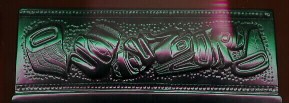
We have a black box with detailed carvings of what appears to be Alaskan design. The carvings look like what you would find on a totem pole. It would be hard for me to even say for sure what they are of but my guess is that there are ravens, crows, frogs, bears and some I can't determine at all. The box is approx. 7"x 5". My first thought was it was just a trinket box but I'm still curious. If you can help me determine any thing about this that would be great. If you have any pictures of native figures would look like I might better be able to determine the ones on the box also.
Thank you for your services.

Sincerely,
Terrisa

A. Hi Terrisa! If the box you speak of looks similar to the picture attached, you probably have a relatively recent reproduction of an Haida style, man made argillite (like) material, box. For approximately 200 years, Haida artists have carved argillite sculptures. Argillite is obtained from Slatechuck Mountain near the village of Skidegate on the Queen Charlotte Islands and as far as I know, this is the only place this is available. If the box you have is a “real” argillite carving, I’m sure it’s value would go into the five figures. It’s fairly easy to tell the difference, but maybe a bit difficult to explain. Probably the easiest way would be to look at the bottom and see if it looks machined, maybe like sanded in one direction. Chances are good that if this is the case, it’s a reproduction. If in doubt, I would contact someone local that can authenticate the box, one way or the other.

Q.  Hi, We have been to Alaska quite a few times, I worked in Juneau on he road from town to Mendenhall shopping area in 1964. While there we purchased a painting from a store downtown by Sidney Laurence, it is water color and framed and mated by WINTER AND POND. We were not able to get much information on the painting nor the company that framed it. Any information or direction to point us would be greatly appreciated. Also while in Fairbanks later, I purchased a silver medal from the Farthest north coin club honoring Sidney Laurence, dated 1974. We would love to have more information. It is hard to come by in the desert southwest of Phoenix.

Thanks for any help.
Gerry Burnett

Sidney Laurence
A.   Laurence is considered Alaska’s most important artist (I personally feel Fred Machetanz is). He also was a  photographer.  I don’t honestly know much about Sidney Laurence water colors or values. I’ve seen oils sell well into 5 figures ($10-$50,000 and I am sure more.) I searched Sotheby’s and found nothing. I checked with other sources and have no recent sales. I looked at a small 10 x 12 oil in 97' for $15,000. I am certain that Braarud Fine Art could provide you with an accurate estimate. To follow are details of Sidney Laurence's Life:

Sidney Laurence 1865-1940

His Life

Born Brooklyn, NY, October 14, 1865.  Studied under marine painter Edward Moran (1829-1901) at National Academy of Design School of Art. Moved to Paris, 1889, entered Ecole des Beaux Arts.  In 1894, a marine painting, "Setting Sun, Coast of Cornwall," won honorable mention in Paris Salon. Two works accepted by Royal Academy of Arts, London, that same year, and another oil and a watercolor in 1895 Paris Salon. Covered Spanish American War for New York Herald in 1898. "Setting Sun" shown that year in 73rd Annual Exhibition, National Academy of Design. Covered South African War and Boxer Rebellion in China as artist for British publication Black and White in 1900. Began work as professional photographer by that time.  Apparently left England in 1902; arrived Juneau 1903 and secured work as photographer. Was in Valdez, 1904. Prospected for gold in summers and worked at odd jobs in winters for several years. Earliest known Alaskan painting "Seldovia, Alaska," 1912 ). Sketched Mount McKinley in summer of 1913; completed "The Trapper"  and another large painting in late 1914 and placed both on display at Smithsonian Institution. Continued work as a photographer in Valdez. He came to the townsite of Anchorage in spring of 1915; opened studio as photographer and watercolorist. Moved into Anchorage Hotel by 1920. In 1924 painted a 6x12 foot canvas of Mount McKinley, now on view at Alaska Bank of Commerce. By 1925, began to spend winters in Los Angeles, painting mainly Alaskan subjects sketched the previous summer. There he met young French painter Jeanne Kunath; married May 8, 1928. In 1929 painted another 6x12 foot McKinley in Los Angeles, now in collection of Alaska Airlines. In the early thirties lived and painted in Washington Hotel, Seattle. Came north to Anchorage Hotel for the last time in 1934. Died in Anchorage September 12, 1940; buried in downtown cemetery. Jeanne Laurence died in Anchorage August 13, 1980.  

His Work

Laurence was already 38 years old when he came to Alaska, and 62 when he married Jeanne. Very Little is known about his early life, and the lack of early examples of his work (and the general absence of dated canvases) make it difficult to trace his artistic development. One can see Edward Noran's training in seascapes done throughout Laurence's life, and also the lifelong influence of French impressionism, which was well established in Paris when he was a student there although it had not yet reached America. A dominant style in his painting is what has been called Luminism. Like impressionism, it was concerned with light and atmosphere, but more realism and an emphasis on the awesomeness of nature. This movement can be traced to Thomas Cole and other founders of the Hudson River school in the 1840's, up through the 1870's. Sanford Gifford, John F. Kensett, Martin J. Heade and Frederic Church are among the better known representatives. By that time, the panoramic western landscapes of related artists such as Albert Bierstadt, Thomas Moran and Thomas Hill were popular. Some, like Church and William Bradford, were turning to the Arctic for new subject matter. Directly or indirectly, Laurence absorbed these laments and other to create his personal style. Laurence was the first professionally trained artist to take up permanent residence in Alaska, and for half a century he has been Alaska's favorite painter. Many of his works are in private collection here, with others on the West Coat, by comparatively few in museums.

Fairbanks Gold Scale
Q. I have a gold scale that I was told was from the Alaskan Gold Rush. It is marked from Fairbanks and has a patent date of 1868. It is very good condition and looks like new. I think it was from Fairbanks, Alaska. Can you tell me anything about this scale?

A. I can't tell you if it was involved with our early Gold Rushes or not, but I can certainly tell you one thing. It's more than likely a Fairbanks brand scale and not from Fairbanks, Alaska. The Fairbanks scale company was started in the early 1830's and continues in operation today. Your scale could have been a scale used during the Gold Rush and if indeed that is the case, would be quite valuable. But, you have to prove it. And if you have no provenance (proof) it's just an old scale.
Fairbanks: In 1901 Captain E.T. Barnette started a trading post near what is now downtown Fairbanks. In 1902 an Italian prospector named Felix Pedro discovered gold about 16 miles north of Barnette's trading. Barnette joined the rush and formed the newest mining community. The town was named after an Indiana Senator, Charles Fairbanks.   

Artwork of Alaska and Seattle
Q.
My elderly aunt has a set of books exactly like the ones on the front page of your web site. She seems to think they are very valuable. They are in excllent condition. Can you tell me if they have much value. 

A. Most of this information is on the main page, but I'll reiterate and I do have some other informationto offer you. 1907 was the year the nine volume collection of the Artwork of Seattle and Alaska was published by the W.D. Harney Photogravure Co.   It contains photogravures by Asahel Curtis, F.H. Nowell, and other well known Alaskan and North West photographers. Although not extremely rare, I've seen the asking prices as high as $1,500 for the set. I recently traded two mediocre condition sets to an associate of mine for a seal skin parka made in Nome by A. Polet in 1938. As far as what I actually think or would estimate a sets value at, in the condition you state, without actually seeing them, I would say $4-500 is a reasonable price. I wouldn't pay that as a reseller but I could as a collector, provided that the condition was excellent plus. I waould say any set, if intact should fetch $200 if complete. It I found a set in absolute perfect shape, not faded, basically mint condition, I would think fair market would be $1,000 safely. Finally, because of the quality of the images, the subject matter and the age, I feel this set is undervalued.    

Back Home

Last updated on January 13, 2005
Contact us