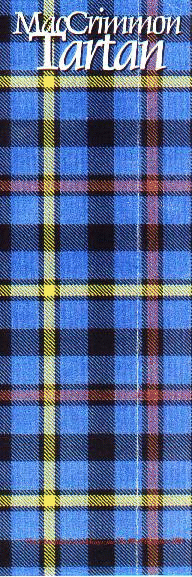
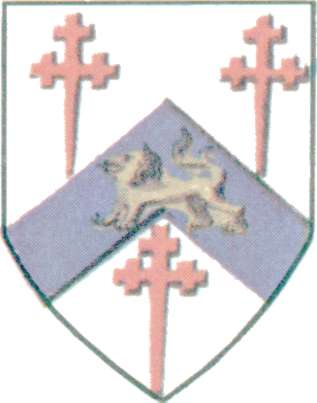
This web site was originally published by my dad, H. D. "Dan" McCrummen, Jr.
On April 15, 2005 he was called by our heavenly Father to join our ancestors, to hear their
stories first hand. I have taken up his work and will endeavor to maintain this page with
accurate information, as he would have. His children, Nancy, Sandra, Mary and myself,
therefore dedicate this page in his memory.
With permission, we have extracted a major amount of
information from the book authored and published by Sonny McCrummen. The listings that
follow are not complete. Not even as complete as the book. This is an ongoing project that
I hope will continue as long as there are descendants
of Malcolm and Mary McCrimmon. I do not know if there are any copies of the
book still available for purchase. There are a number of copies out there
and I would expect that one could be found that you could inspect. This is
a first attempt by me to place a site on the world wide web. I hope I am
successful. I will be updating the site as I have time. If you have any
information that you feel would be of help to others who might be studying
this history, please send copies to me and as I have time I will add it to the
site.
H. D. "Dan" McCrummen, III
USPS: 6742 Sherri St.
a book by Robert A. “Sonny” McCrummen
The name, McCrummen, comes from the Gaelic MacCruimein and has taken
several different forms. Dr. I. F. Grant in her book "The MacLeods",
states that "even in the 18th Century I have found McCrumen, McCrimmond
and so late as 1824, MacGriumen." Frank Adams in his "The Clans, Septs,
and Regiments of the Scottish Highlands", states "of the hereditary clan
pipers the best known were the MacCrimmons or MacCrummens, pipers to the
MacLeod of Dunvegan." Poulter and Fisher in "The MacCrimmon Family" found
the following forms of the name in two of the MacLeod documents: 1614
MacCruinnein 1616 MacCriummen 1626 MacCrimon 1664 MacCrimmon
1717 MacCrumen 1792 MacCrummen 1815 MacCrimmon.
Mr. Donald F. MacDonald of Glasgow, who writes under the pen name of Allan
Douglas for the weekly Scotsman newspaper, feels that the name comes from Old
Norse, as found on one of the ruins ª inscribed crosses at Kirk Michael on
the Isle of Man. Mr. MacDonald's sister-in-law, a Celtic language honor
graduate of Edinburgh University concurs with his opinion. They feel, along
with others, that there is no basis for the fanciful Italian origin of the
MacCrimmons repeated by Mr. Fred T. MacLeod in "The MacCrimmons of Skye".
It appears that the MacCrimmons were established in the Outer Hebrides prior
to 1200. The Bannatyne Manuscript describes the MacCrimmons as holding lands
in the South of Harris during Norse rule and under the rule of Paul
Baalkasom, Sheriff of Skye. Sometime about 1500 the family became associated
with the MacLeod family. The MacCrimmons became the hereditary pipers for
the MacLeod of MacLeod in exchange for land on the Isle of Skye. It was here
on Skye that the MacCrimmons established their famous piping college. The
relationship between the MacLeods and MacCrimmons ended about 1770. There
appears to have been two or possibly three branches of the family; the
MacCrimmons of Skye, of Inverness and of Glenelg. The MacCrimmons of Skye
were the more prominent branch. The conditions in Scotland after the Battle
of Culloden in April, 1746, encouraged the Highlanders to migrate to Canada
and the United States. The 1770's were years of large migrations to North
Carolina. Most Scots who came to the United States landed in the Cape Fear
region of North Carolina. From the Cape Fear region they moved inland (I
feel that our ancestors settled in Moore County, NC). The census records of
the State of North Carolina for 1790 spelled the name as McCremon, with
members of the family living in Moore, Robeson, and Cumberland counties.
The first primary source that I have found, that can be traced to our family,
that spells the name as McCrummen, is the marriage record of John McCrummen
in Bibb County, AL. Evidently, the name was at one time pronounced as if it
were spelled "McCrimmon." My grandmother, Mrs. Clyde McCrummen, still
pronounces it as if it were spelled McCrimmon. Today, it is still pronounced
as McCrimmon by people in Cherokee County, TX who know the family. I have
found the name spelled in several different ways but I feel it will be
difficult to determine the exact spelling used by our immigrant ancestor
when he came from Scotland. It is possible that it was spelled as McCrimmon.
It is more possible that it was spelled McCrummen, in that it was spelled
that way in the 1700's during the time our ancestor came to America.
Sonny McCrummen
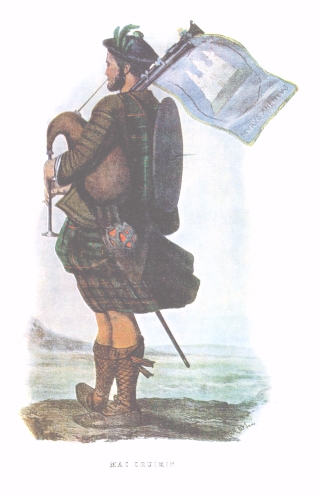
MALCOLM McCRIMMON - WHAT WE KNOW
It is believed that Malcolm McCrimmon was born in 1742 in Scotland. It
is assumed that he was born on the Isle of Skye, as this is the traditional
home of the McCrimmons. However, some of the family were living across from
the Isle on the mainland during the time Malcolm emigrated to North Carolina.
There is no record of his parents and there are few extant records in
Scotland for this period of time
It is believed that Malcolm arrived in North Carolina in the early 1770s.
An old family letter indicates that he married a Mary Monk, who came over on
the same ship. The same old letter indicates that there were two sons, John
and Daniel, however, the 1790 census indicates three small male children were
in the home. The old letter also indicates that Malcolm served a seven year
indenture to pay his passage. This would indicate an individual of limited
means as were most of those arriving from Scotland at this time.
It is believed that Malcolm claimed his first land grant in Moore County
in 1786. There are numerous other later land grants to Malcolm McCrimmon but
the identity of the individual claiming them is confused as another Malcolm
McCrimmon arrives on the scene sometime around 1800. This individual was born
in 1775 in Scotland and was the son of Norman McCrimmon. This father and son
arrived in Cumberland County around 1788 and lived there for several years.
They then moved into Moore County. However he came of age around 1790 and
was eligible for land grants. It is evident that many of the land grants were
his. The earliest of these grants however can be assumed to be those of our
ancestor.
The "other Malcolm", the son of Norman, remained in Moore County and became
a prominent citizen. He had a large family and his son, Norman, was the
enumerator for the 1850 census for Moore County. His descendants remain in
the area today.
Our Malcolm is again identified as living in Moore County as he is listed in
British Aliens in the United States 1812. It is this publication which
gives us his birth date and the approximate date of his arrival in North Carolina.
In 1813 he is listed as being 70 years old with a wife and seven children.
Three of these are assumed to be the three male children noted in the 1790
census.
Malcolm seems to disappear at this time. It is possible that he may have
moved west. A Malcolm McCrimon purchased land in Tuscaloosa County, Alabama
in 1821. In addition, an elderly Malcolm is listed in the 1830 Tuscaloosa
County census. The census indicated he was between 80 and 90 years of age.
The same old family letter indicated that our ancestor lived to be 106-7 years
of age. Also, Tuscaloosa County is very near Bibb and Perry County to which
Malcolm's son and grandson eventually moved.
There are no other known records of this individual.
Sonny McCrummen
If you have additional information, we would like to hear from you. Dan
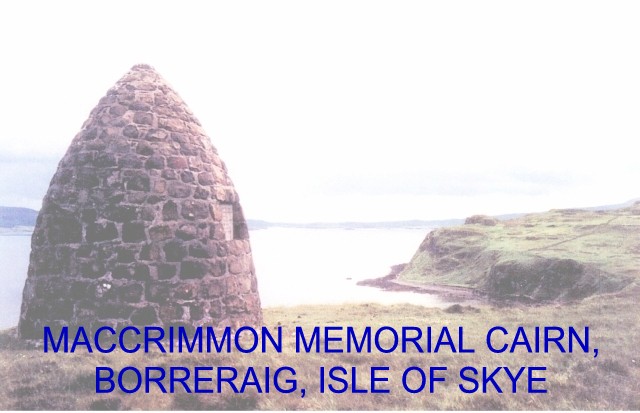
Malcolm McCrummen
m. Mary Monk
- Daniel McCrummen b ?/?/1784 d. 10/7/1873
m. Hannah Dunlap
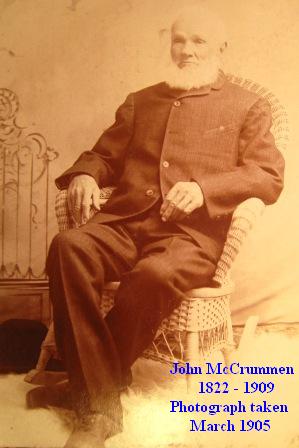
- John McCrummen b. 8/1/1822 d. 3/20/1909
m. Mary A. Suttle b. 5/16/1822 d. 11/15/1901
- Daniel H. b. 1840 AL
- John S. b. 1841 AL
- Mary Elizabeth b. 1845 AL
- Margaret Evalin b. 1847 AL
- Jessee Cornelius b. 1850 AL
- Sarah Monteray b. 1852 TX
- William Talley b. 1855 TX
- Malcolm Caruth b. 1857 TX
- Luther Myars b. 1860 TX
This link will take you to the site of the Myrtle Springs Cemetary where
Daniel McCrummen is buried. Also other members of the McCrummen family are buried there.
CLICK HERE
This link will take you to the site of the Cedar Hill Cemetary, also in Cherokee
County where additional McCrummen family members are buried.
CLICK HERE
This link will take you to a site of the Lubbock cemeteries where several McCrummen
family members are buried.
CLICK HERE
This link will take you to the site of the Evergreen Cemetery in Lamar County where
several more McCrummen family members are buried.
CLICK HERE
NORTH CAROLINA TO TEXAS
Malcolm McCrummen, born in Scotland, immigrated to North Carolina around
1770 and married Mary Monk, who also immigrated from Scotland on the ship
with Malcolm. To pay for their passage to the United States, both Mary and
Malcolm worked for seven years before they married sometime around 1780.
(There is some speculation that Malcolm left North Carolina and went to
Canada with his father for three to five years between 1772 and 1778.
He then returned to North Carolina, when his father returned to Scotland.)
They had at least two children, Daniel, in 1784 and John, in 1787. Both
were born in North Carolina. Some sources seem to indicate daughters and more
sons were also members of the family. Daniel's brother John seems to have
stayed in North Carolina. Daniel married Hannah Dunlap and they had a
son, John in 1822. Hannah died shortly after John's birth and Daniel
married her sister, Mary Dunlap. Young John married Mary Suttle on
2/7/1840 in Bibb Co., AL. They moved from Bibb County, AL to Cherokee
County, TX around 1851. They settled in a town called Lone Star, which
no longer exists. The town of Ponta remains, which is near where Lone Star
was and is where Daniel McCrummen is buried. Daniel died on 10/7/1873 and
is buried in Ponta, Texas.
Sonny McCrummen
History of John McCrummen
This is the life history of John McCrummen who was born
in 1822 in Moore County, North Carolina. He was the son of Daniel and Hannah
Dunlap McCrimmon and the grandson of Malcolm and Mary Monk McCrummen.
This document was prepared about 1928 with
the author being unknown. A small part of the final pages of the original
manuscript has been destroyed by time. An attempt has been made to retain the
original sentence structure, spelling, and punctuation. This manuscript was
provided by Mrs. Marie McCrummen Rodgers of Lindale, Texas.
Chapter 1
Ancestry and Boyhood of John McCrummen
We have no difinite trace of the ancestry of John McCrummen at hand, except the
fact of Scotch descent. This is proven by the change in the spelling of the
name which will be noted at the proper time.
John McRimmon was born on August 1, 1822, in Moore County, North Carolina. His
mother died when he was four weeks old. She could not be reconciled to die
until God impressed her he would care for her infant son, then she dedicated
his life to the Lord and died peacefully.
His father, Dan McRimmon, later married again. They lived on a worn out farm.
The parents were of very limited means so the son, John McRimmon was deprived
of the advantages of an education. In his early boyhood his father moved to
Bibb County, Alabama and lived on a farm there as poor and worn out as the one
he left in North Carolina. They worked hard for a bare living. It was during
this period of his boyhood that he batched with a negro boy, called Al, a slave
of his father. The chair he used than and sat in at night studying by a log
fire is still in the family. His characteristics of thrift was shown early
in his life when as a young boy he would go th the county fair and sell Ginger
Cakes and cider.
Chapter 2
Young Manhood
At the early age of seventeen years John McRimmon married Miss Mary Ann Suttles
on the 9th day of February, 1840. He and his wife were very near the same age,
her birthday having been May 15th, 1822.
They moved themselves to a one room log cabin on his fathers farm, with a
wedding present of one slave from her faather. The furniture was of a crude
home-made sort. It was the day of puncheon floors and seats. The table
and seats were made of hewn logs. The bedstead was made by placing the
ends of poles into holes bored in the log walls of the house. These things
do make for strong character in people: but there can be no question as to
the lack of luxury.
They lived very economically. His first year store account was twenty dollars.
From this statement we get a more concrete idea of the privations. Even now
one can see the bare clay hills of a large portion of Alabama and wonder how
folks can make a living there. In truth, it is very much now as it was then.
There is, then, no doubt that these hardships and privations had a
direct bearing as a cause for their immigration to Texas. We know something
about the wonderful stories they were hearing then of the country in Texas
and this in turn explains to us why they were willing to undertake a journey
so dangerous and difficult. People becoming dissatisfied with their
surroundings, will, if accompanied by sufficient courage, make some effort
to better conditions.
During the time they lived in Bibb County,
Alabama, five children were born. They were Daniel H., John S., Mary
Elizabeth, Margaret Evaline and Jessee C.
Chapter 3
Emmigration To and Early Life in Texas
In 1849 John McRimmon loaded his wife, five children, seven slaves and all
his possessions in wagons and together with several other families interested
in emigration, formed a train of covered wagons, some drawn by horses, other
by oxen, they started for Texas. The slaves and some of the white people
walked most of the way. The women and children rode in the wagons with the
household goods.
After a journey of six weeks they arrived in Cherokee County, Texas. Some
relatives had preceded them by train and boat to this place. These relatives
reached Shreveport and lost two of their number from yellow fever.
The family we are tracing built a log cabin with puncheon floors, a few miles
east of Rusk, Texas, the County seat. This cabin was located three miles
from Coney Creek. They were so far from their neighbors that they had to
blaze their way to their house- that is cut a large chip off the tree now
and then to mark the road to follow through the dense forests-.
There was no regularity about the homestead location, each family built
near a spring for water. They were happy to find a fertile country and
one where corn grew as high as the house.
Having worked and saved they were able to buy and improve a better and
more desirable place, located on the main road from Henderson to Rusk.
As soon as sufficient shelter for the family was built they moved and the
little daughter, Margaret Evaline, then five years old, insisted on
running along behind the wagon. Now, Mrs. Eva Knight at the age of 81
years said, "I wanted to move and gathered the idea, when two years
old, from our journey to Texas, that when moving, one must move oneself."
The new home was a very large house built of split pine trees
and ceiled with planks. They built the huge fireplace and chimney of
sticks and mud. The kitchen was built apart from the house about fifty
feet. The reason for this was the fact that cooking over an open fire
would make the house dirty and smoke scented. The food then needed to
be carried to the house to be served. A well, which was an unusual luxury,
was dug near the house. The slave quarters were some distance from
the house.
Here, too, they kept the stage stand. This carried with it the responsibility
of feeding all the passengers on the stage, also the care of the teams of
relay horses. As the stage came down a long sloping hill about one half
mile from the house, the driver, Bill Rickets, would blow his bugle. At
this signal the food, which was always bountiful and ready punctually,
was served on the table ready for the travelers, usually numbering as many
as could possibly ride inside and on top of the stage. The Hostlers had the
fresh team harnessed and ready to hook up immediately upon the arrival
of the stage. This particular part could be done while the people were
eating. Promptness, however, always prevailed and the stage stop was
requlated only by the time taken up by the diners. Mrs. Knight said,
"Everything was on time at our house." This was a regular dailly occurrence
for breakfast and dinner. The travelers were not fed when the midnight
stage came, but Bill Ricketts always found a pot of hot coffee on
the hearth of the living room. He always found time to hurriedly
drink a cup of coffee while the teams were changed. The stage stand
was not the only activity. The improvement of the home and farm went on
systematically. The number of slaves had increased and the boys were
large enough to work.
They built a cotton gin, griss mill, and a syrup mill. By working hard
they could gin and press two bales of cotton in fourteen to sixteen
hours. They also raised sheep for wool to make their clothes. After
clipping time in the spring the wool was washed, and carried to the
nearest carding machines. After it was carded it was put away until the
time came to spin and weave it.
John McRimmon rose at four
o'clock every morning, and personally supervised the preparation for the
days work. He then went back to bed and stayed until a late breakfast.
M. C. McCrummen said, "there was a little creek that ran
through our lot. It was called Comey Creek. About a mile from our
house it ran into Mud Creek. Here they had fish traps. After all were
through with their work on Saturday afternoon they would go there to
hunt and have a good time. Here the boys learned to swim."
The children went to school to a very efficient school teacher at the
settlement school house, which was about three miles away. They
usually walked but when it was muddy toe smaller children rode a little
mule called "Bird."
John McRimmon was an excellent disciplinarian
and controlled his entire household with kindness and positiveness.
This kindness was evidenced by the cows, horses, chickens, the
inhabitants of the entire barnyard following him when he arrived on
the scene. Each nudging the other out of the way to receive one of
his caresses. We was exceedingly fond of all kinds of animals and
gradually accumulated a considerable number of them. He always kept them
fat and slick and when in that shape, they were fine to him.
A traveler came through the country and when he reached the McRimmon
place had a sick mule. He told John McRimmon if he would let him have
a mule he would leave his sick mule and when he reached home would
send him a deed to a track of land in Lamar County, near Paris, Texas.
John accepted the trade. In about a month the deed arrived and his
confidence in the man was confirmed. By this time his entire life
broadened. The number of slaves had increased and others were
bought. His other assets had grown and he had reached the stage of
a successful farmer. He was much beloved and honored by friends,
family and slaves. He was a man whose business came before pleasure,
but he always enjoyed the recreation time himself, and would often
spend the twilight hours being entertained by the music and songs
of the slaves. Especially did he like the knocking of bones held
between the fingers of one negro boy, they called this tomborees and
it was accompanied by such dance steps as, out the pigeon, knock the
back step, chicken in the bread tray picking up dough, etc. At
Christmas time he would tell his slaves they could take Christmas
just as long as the back log of the fire lasted. Invariably they
searched through the thick forest, for the largest hickory tree that
they could find. After the selection was made and the log was cut,
it was rolled in the creek to soak full of water. This water-soaked
green hickory log would burn for about three days and nights and the
slaves would have a fine vacation.
John McRimmon enjoyed having dances and parties at home for his children
and sat smilingly patting his foot as he saw his children and their
friends promenade and swing their partner in the old square dance,
minuet, and other fiqure dances. In the meantime Mrs McRimmon was
personally seeing that the guests were all enjoying themselves and
having abundant refreshments.
Early in the evening was a busy time on the farm and among other
things, the considerable number of both white and black children were
bathed, fed, and put to bed, before the farm hands reached the house.
The regular supper for the negro children was a large pan of bread
and milk, placed in the back yard. Each "pickaniny" with a spoon,
big white eyes, and a circle of white around the black mouth as
they scraped the pan, was a sight to be remembered. The yodel of
the negros, slowly plodding their way home, with their hoes on their
shoulders, was the signal to all the children on this farm to go to
sleep.
The negro women each had their regular tasks and the name of the
house girls were Rose, Caroline, Rhodie and Harriett. The cooks were
Rachal and Sock and a few other slave names were Big Jerry, Little
Jerry, Lot, Ben, Bose, Miles, El Morris, Wess, Abe and others.
For several years, John McRimmon lived happily and prosperous. The
Golden Rule was his guide. He believed all men were honest until
they proved otherwise. His own word was as good as any mans bond,
and to question his word was to question his honor. This was a very
dangerous thing to do to this calm, kind, fearless, six foot Pioneer
Scotsman.
John McRimmon, after awhile, became a money lender
and for a long time only gold was handled. When a man borrowed a
certain amount of gold he would obligate himself to return it at a
certain time and would ride miles in any kind of weather to make his
word good by returning the gold. He liked to help people who tried to
do something, the unfortunate and sick but did not care to help the
shiftless kind of folk.
A little story that is remembered
evidenced this fact. A man came to his house one winter day and was
seated by the big fire-place in the living room. He talked of things
in general, for several hours. During this time he struck a number of
matches to light his pipe. Finally he stated his business. He wanted
to borrow some money from John McRimmon. The latter simply stated, it
would not be his policy to lend money to a man who would waste matches
when there were plenty of fire-coals within easy reach.
During all these years John McRimmon had not ceased to study. He
never aspired to learn or follow a professional life. Judging from this
his study must have been along the lines of business administration.
We find at different times during his life, contracts or papers of
that character which he had written with a short lead pencil in just
sort of blank paper, held in the courts. This proved true in several
cases after one or more transfers from him.
Chapter 4
Civil War Period
John McRimmon was over-age when the civil war broke out. But he was a
true Southerner in that sense of the word.
By this time he had
several slaves and he formed a company of negroes. It is presumed he
got other negros around the community besides his own. He intended to
take this company of negroes someplace to be outfitted for service. He
got to some point near Houston, or Beaumont, Texas where the negroes
became frightened or hungry. They "pulled up stakes" and returned
home. Thus they left John McRimmon to return from his war experiences
alone.
His oldest son, Daniel, was just the right age to make
the best soldier. He was ready and enthusiastic to go the the war.
He was among the first group to leave that section of the country.
The night this group of young men gathered preparatory to leaving
for the army, they camped on the creek near the house of John
McRimmon. The people came with their husbands, sons, and sweethearts.
The following day a big dinner was served. It was a picnic dinner
served on the creek bank from baskets of food brought by these people.
Daniel was in the midst of the group of young men, dressed in a new and
hansome uniform. All were happy. Laughter and shouts of greetings
echoed throughout the crowd. The one who would have failed to enjoy the
dinner was not there. Some time after dinner the bugler blew
assembly, the young men in their new uniforms seemed instantly to
be standing by their fat, slick and spirited horses. Then another
bugle call and all were in the saddle and gone like a flash. Weeping
that had been more-or-less absent before, began in ernest now. They
seemed to realize the changes to befall before these men were to
return.
John McRimmon had consoled himself after the negros
had abandoned him, and the expedition to Beaumont or Houston, by doing
his utmost at home in the way of helping to care for the soldiers,
but when his oldest son, Daniel, left for the war, it was almost more
than the father could stand. He prayed throughout the war for the
safety of his son.
The women and negroes carded the cotton
by hand, spun the thread on a spinning wheel, made the cloth on the
loom and made all the clothes for the family, besides clothes for the
soldiers and slaves. John McRimmon was very proud of his baby girl,
Sarah Monterey, then about nine years of age. She could spin about
twelve cuts of wool in a day. Three cuts would make a yard of cloth.
This depended of course upon the coarseness or fineness of the cloth.
A certain slave tanned all the leather and made shoes for
the entire household and for the soldiers. This negro dug a square
hole in the ground and filled it with bark, from red oak trees, and
water. This was called red oak coze. The hides were placed in this
vat and left until they were tanned.
On Saturday afternoons
the wives of the soldiers would bring their sacks to the grist mill
and have them filled with a week's supply of meal. John McRimmon
did all he possibly could to help them. John S. McRimmon, the second
son, seventeen years old, could not join the army because of defective
eye sight, so he was given a courier line to ride in North Texas from
Clarksville to Honey Grove. On this courier line he had some very
interesting rides, and several narrow escapes from the Yankees.
About this time his younger brother Jesse C. who was then about
twelve years old left home burdened with clothes to carry to his brother
John S. Before he left the women had made him a handsome suit to wear
on the trip. It was made of blue and black thread twisted and woven.
On the road his mule got sick, and a stranger who liked the boys looks
and appreciated his nerve to make a serval hundred mile trip at such
times so young, he let him have a mule to finish his journey on.
During the war the Stage Stand was not such a pleasant business.
Before it had been the house by the side of the road. But with the war
began the transportation of prisoners. When they came on the stage
chained together, they caused no little fear and trembling among the
women and the children of the household, and a great sigh of relief was
heard when the driver cracked his whip and the horses dashed away with
their unwelcome passengers.
Chapter 5
Reconstruction
John McRimmon plodded on through the years, praying
always, working always, helping always, until one day the news came that
Lee had surrendered. He knew then that the negroes were freed, which
meant to all the South financial disaster. Facing this bravely and without
complaint, as he believed it to be the will of God. John McRimmon carried
on. His slaves stayed with him, some he rented land to, others he paid wages.
He continued his stock farming with very little disturbance and the great
thing he had to be thankful for, was that his son Daniel was soon to
return uninjured. The day Daniel came home, his brothers and sisters
went up the road to meet him. The negroes ran in every direction, all
trying to get the first glimpse of Marse Dan -- and when this splendid specimen
of young manhood did appear, there was great rejoicing. He wore a pair
of trousers made of a wagon sheet which he cut out with his knife and
made with his hands with the needle and thread that his mother had put in
his kit. It was interesting to hear him tell the story of their last
encounter which was near the historic old town of Santa Fe, New Mexico.
 The Yankees were on one side and the Confederates
on the other of a rounding hill. There was a pass through the hill. The
Confederates discovered the Yankees could see them as they went across this
open space. They only had a little hand full of men and they knew they
were much outnumbered by the Yankees; so they had their men ride by this open
place over and over again. The Yankees thought that there were hundreds of them
and did not attack. The Confererate dared not attack because of their few
men and practically without ammunition, so in the middle of the night they
loaded a couple of wagons with all their belongings, wrapped the wheels with
blankets so that they would not make a noise, set fire to the rest of the
wagons and stealthily slipped away. In the meantime the Yankees know they
would have no chance if they came to battle with such a great number of
men in gray and they just as stealthily slipped away miles in the opposite
direction. When the sun of early morn spread its golden mantle over the
expected battlefield, only the smoke from the burning wagons raised shadows
against the rays. The enemy were far apart. Soon thereafter the end of the
war came and these brave fellows with tattered clothes, bleeding feet and
heavy hearts, started on their long hike to San Antonio, across the desert,
and then to their respective homes.
The Yankees were on one side and the Confederates
on the other of a rounding hill. There was a pass through the hill. The
Confederates discovered the Yankees could see them as they went across this
open space. They only had a little hand full of men and they knew they
were much outnumbered by the Yankees; so they had their men ride by this open
place over and over again. The Yankees thought that there were hundreds of them
and did not attack. The Confererate dared not attack because of their few
men and practically without ammunition, so in the middle of the night they
loaded a couple of wagons with all their belongings, wrapped the wheels with
blankets so that they would not make a noise, set fire to the rest of the
wagons and stealthily slipped away. In the meantime the Yankees know they
would have no chance if they came to battle with such a great number of
men in gray and they just as stealthily slipped away miles in the opposite
direction. When the sun of early morn spread its golden mantle over the
expected battlefield, only the smoke from the burning wagons raised shadows
against the rays. The enemy were far apart. Soon thereafter the end of the
war came and these brave fellows with tattered clothes, bleeding feet and
heavy hearts, started on their long hike to San Antonio, across the desert,
and then to their respective homes.
Not long after arriving home
Daniel was quite himself again and with a new suit, a buggy and a pair of fine
horses he started across the creek to pay a visit to a fair young lady. As he
dashed along he said the owls would say, "Who, who, who are you" and with
great pride he would rear back and pull the reigns over the slick backs of his
horses. After a pleasant evening, with all his gallantry he bid the "fair-one"
good night and started home. Just as he reached the creek bottom where the
road was muddy and dark as midnight under a "skillet," something about his
harness broke. He tried repeatedly to find it but couldn't. His clothes
were all muddy, his boots which had been so perectly blacked, were ruined.
He felt very much discouraged and he said the owl above his head, sitting
in one of those pine trees so tall the top tickles the feet of angels, said
to him, "Who, who, who are you now."
Records show D. H. McCrummen, Fifth Sargent, Company
F, Seventh Texas Cavalry
Soon after the war was over
some Yankees came to John McRimmon's farm and demanded his mules and horses.
John McRimmon argued with them and tried to persuade them to let him alone.
They persisted and started after the mules. His eldest daughter, then about
sixteen years of age, was in the yard listening. John McRimmon turned and
said, "Elizabeth, bring my gun." She rushed in the house and brought the
gun to her father and bravely stood by his side while he convinced the
Yankees that he meant to keep the stock, which he did.
Many people
were ruined entirely and moved from one place to another in their discontent.
A man came by one day who was sick and trying to reach some of his folks.
He told John McRimmon that he would sell him about three hundred acres
of land near Beaumont, Texas, at twenty-five cents per acre if John McRimmon
would buy it. John McRimmon bought it, he didn't even know the exact
location. He let the sick man have the money and the man went on his way
rejoicing.
John McRimmon had made a great deal of cotton during
the war and did not sell it until after the war when he sold on a very high
market and used this money to help people get their farms started again.
John McRimmon sent the older children away to school, and then the younger
ones to Rusk for awhile. Later he rented a house and had the oldest
daughter go there and take care of the younger children until they finished
the Rusk Academy. The children remember with tender feelings Old Miles, one
of the slaves that went with them to look after them all.
Dr. John Joss was president of the Rusk Academy. He was a most intresting
man, a native Scot, and often spent his week-ends on the McRimmon farm,
going home with the children on the Stage Coach. He and the father
became good friends because they had so many things in common. John
McRimmon's people having died when he was so young and having left
his old home he had lost track of his ancestors, except that he knew
that his grandfather came from Scotland. Dr. Joss had known the McRimmons
in Scotland and with many other interesting things told him, his name
was spelled Mc-C-r-u-m-m-e-n. John at once adopted the correct spelling
of his name.
When the old professor came out, all the best
hunters in the country were notified and they would have great deer hunts.
They carried pans on their heads with pine torches in them to shine the
deer eyes. On one occasion M. C. McCrummen, then quite a youth, went
along and was given supposedly the very worst stand. While all were
eagerly waiting for the big game to appear the air was rent with yells.
Everyone near enough rushed to the spot and found the youth had killed
a huge buck and his ecstasy was amusing. As he continued to jump
up and down to yell. The father and Professor were much pleased by
the nerve and the "crack" shooting displayed by the lad.
(Note--M. C. McCrummen, known by his brothers and sisters as "Makey",
now lives in Lubbock. He moved there in 1901.)
The children were sent on to higher school, the best available. The
youngest son finished business education in Poughkeepsie, New Yark.
The fourth son, W. T. McCrummen went to Lamar county, to the land
that his father had traded the mule for, and to his surprise found
a fine black land farm, which later sold for eleven thousand dollars.
John McCrummen became interested in the mercantile business, and he
and his sons engaged in this business for many years though never
diminishing his stock farming. His childdren married one by one
and he told an amusing story of how he acted when the oldest son,
Daniel, married. He went to bed and tried hard to be sick. Later
years he loved Daniel's wife like a daughter and thought his first
grandson, Lee McCrummen was the finest boy in the world.
John McCrummen also tells how E. A. Frazer asked him for his baby
girl, Monterey. When he approached John McCrummen with more fear
than he showed at seventeen in the first skirmish of Walker's
Division during the late war. Ed said, "Mr. McCrummen a short
horse is easy curried. I want to marry your girl."
It was quite a fad for young ladies to dip snuff at this time
and John McCrummen didn't want his daughters to do this so he
gave each of them a set of jewelry composed of breast pin, ear
rings,bracelets, if they would not use snuff.
After the
children had all married and left home John McCrummen gave two
orphan boys a home and kept them until they were grown.
John McCrummen moved to Lone Star, a little town about ten miles
away, and sold his home and bought another and added a farm
after farm to his estate and continued to own gins, mills,
a blacksmith shop and General Merchandise.
Religiously, John McCrummen was a Universalist in belief and
in this little town of few Churches the other denominations
wouldn't let a minister of this belief preach in their churches
so he built a church and with the help of a little hand full
of people, installed seats, organ, etc., and had the best
place in town to worship and it was open to all denominations.
After a few years the other churches being unkept were unsafe
to worship in and their following preached their own doctrine
in John McCrummen's church.
On the Golden Anniversary of John and his good wife the
children and grand-children all met at their home for one
great reunion and the famous grooming of the table with the
good things to eat was very evident.
At some later date John McCrummen decided to have a revival
meeting at his church. The preachers, singers, and visitors
were all welcome and at home at John McCrummen's house. At
the first meal he announced in his hospitable way, "You people
will be welcome just as long as the coffee is strong," and
much to the amusement of the guests, when Mrs. McCrummen
raised the coffee pot and proceeded to fill the cups, she
discovered that the cook had only boiled the water and had
forgotten the coffee. Although much embarrassed and amused
after her husband's fine speech, she soon had the cups filled
with delicious coffee of the right color and aroma.
John McCrummen's faith in his fellow man was shown clearly
in the filing of important papers in a combination safe
that sat on the front porch. This was his office where
most all his business was transacted and he kept his money
in a little trunk that was never locked, under the head
of the bed. The children constantly feared that someone would
harm their father with intention to rob him, but he made
no change as long as he lived at this place.
Things went along very uneventfully for afew years, when
suddenly one day a telegram came asking if John would
sell eleven acres of land near Beaumont, which he had paid
twenty-five cents an acre for. He immediately sent his
son J. C. McCrummen to see about it. He found that the
Wildcat, Lucas Gusher had blown in, flowing hundreds of
barrels of oil a day. John McCrummen closed the deal for
the eleven acres for a large sum of money and had the
balance left in a rice farm which sold later for a
good price.
John McCrummen was getting along very well and his nine
children also. They did not need this money for any
immediate use so John McCrummen and the good mother
decided to divide this money into ten parts and give
each child a part and keep one for themselves. Then
arose the question of investment. They all got together
and decided to send M.C. McCrummen and the oldest grandson,
Lee McCrummen to hunt cheap land as a investment. They
were charged by John McCrummen not to hunt kinfolk nor
friends but go till they found good land. They went to
Big Springs on the train and over land on stage to Lubbock,
while they seemed to make fairly good time, they never did
overtake two men who were carrying a stick on their
shoulders with a barrel on it. They found it proved
to be a mirage. Arriving at Lubbock they were unloaded
at the old Nicollette Hotel. They soon looked over the
thirty houses in the town, met most all the people and all
gave them the same glad hand and made them feel that
Lubbock was the biggest little town in the west. Alshough
it was very dry, they believed this to be the right place to
invest and after looking around they bought eventeen
sections of land, the old Butler ranch, later added nine
sections to that place. Then still later bought fourteen
sections four moles notrhwest of Lubbock from A.M.Clayton.
This land had been homesteaded by a man whose name was
Shannon. In the section used for horse pasture nearest
town, there is a spring which is supposed to be the source
of the Brazos river and not far from this place was
located the first Post Office of Lubbock in a little
store. That same year, 1901, M.C.McCrummen moved to the
Butler ranch and others in the family began talk of
moving west. John McCrummen and his wife decided they,
even, wanted to go west. He began to sell off his lands
and was soon to be going. When the helpmate through all
his trials and posterity became ill and on November 15,
1901, died. It was a truly an affecting scene, the
gray haired sire who had walked hand in hand with this
sweet spirited woman over half a century, leaning against
the pillow upon which lay the head of his dying wife,
six noble and tender hearted sons and three devoted
affectionate daughters standing around the couch to watch
the first link drop from the circle and the youngest
son was forty-two years old.
John McCrummen then seemed more anxious than ever to
move west as he must take up a different life without
his ............ .......... .... John McCrummen,
together with his daughter ....... ....... L.M.Knight
loaded emigrant .......... the stage, to Lubbock.
They resided in a well built ranch house built of
lumber hauled from Colorado City, Texas, more than
one hundred and twenty miles.
As the weeks passed conditions were discouraging and
their location very lonely as about the only noise
heard was the howling of the coyotes very near the
house. The nearest neighbor was four miles away.
Coal, groceries, and everything that they used was
freighted by wagon from Big Springs or Canyon.
There had been no rain in Lubbock for several months
and this was rather discouraging as John McCrummen
had been accustomed to having his seed all planted
by April, and it was now June. But the spirit of the
west was shown in the becoming face of Uncle Gus
Carlysle when he would say, "We have plenty of time
to make a crop." The first of July came without rain.
John tried to assume the western spirit, but was somewhat
dismayed. About the fourth of July a reavy rain fell.
The seed was soon in the ground and a fine crop harvested.
John McCrummen was then convinced of the virtue of the
soil and knew he had invested well. The cattle on the
ranch were properly cared for and as a whole the first year
was profitable.
ABOVE UNDER CONSTRUCTION
to be continued
GENEALOGICAL TREE
Explanation of outline used for tree:
1 Malcolm McCrimmon b: abt. 1742 d: abt 1848
1 Mary Monk b: unknown d: unknown
- 2 Children
m. spouse
- 3 Grandchildren
m. spouse
- 4 Great-Grandchildren
m. spouse
- 5 Gr-Gr-Grandchildren
m. spouse
- 6 Gr-Gr-Gr-Grandchildren
m. spouse
- 7 Gr-Gr-Gr-Gr-Grandchildren
m. spouse
- 8 Gr-Gr-Gr-Gr-Gr-Grandchildren
m. spouse
- 9 Gr-Gr-Gr-Gr-Gr-Gr-Grandchildren
m. spouse
- 10 Gr-Gr-Gr-Gr-Gr-Gr-Gr-Grandchildren
m. spouse
- 11Gr-Gr-Gr-Gr-Gr-Gr-Gr-Gr-Grandchildren
m. spouse
We hope this tree is of assistance to you in understanding your heritage.
To identify a certain location so others can find it please use the numbers and letters in full.
As an example, my name is located at 1,2C,3C,4E,5J,6C. Some names will go on for 10 or 11 numbers.
I hope this method will assist in faster viewing of the desired people.
Some dates are given as month - day - year.
Where possible, the location of birth and the location of burial is given.
1A The Family of Malcolm and Mary McCrimmon
2A Unknown (Females) McCrimmon unknown- unknown
2B Unknown (Males)(John?) McCrimmon unknown- unknown
2C Daniel McCrimmon North Carolina? abt ?/?/1784 - (Lone Star, Tx.) 10/7/1873
m. Hannah Jane Dunlap unknown - 1822
3A Mary McCrimmon 1817 - 1900
m. Nathan Wallace 1818 - 1876
4A Sarah Wallace 1839 - 1913
m. Cornelius Hasseltine Jones 1831 - 1872
5A Bernice Jones unknown
m. R. H. Hunter unknown
6A Bonnie Hunter unknown
m. N. C. Garrison unknown
7A Hunter Garrison unknown
7B Neil Garrison unknown
m. A. E. Simpson unknown
6B Mary Hunter unknown
6C Lulu Hunter unknown
m. R. A. Smith unknown
6D Rush Hunter unknown
6E Sarah Hunter unknown
6F Harold Hunter unknown
2nd Husband of Sara Wallace
m. J. C. Bowden 1828 - 1884
4B Lucinda Wallace 1842 - 1918
m. S. R. Sessions, M.D. ?? - 1877
5A Nathan Sessions unknown
5B Daniel Sessions unknown
4C Mary E. Wallace 1844 - ??
4D Daniel Houston Wallace 1848 - 1927
m. Laura Ellen Knight 1852- 1915
5A David Overton Wallace 1872 - ??
m. Nita Montgomery unknown
6A Philip Wallace unknown
6B Marjorie Wallace unknown
m. Merrill Heisey
5B Martha Clementine Wallace unknown
m. ?? Holcomb unknown
5C Lilly Wallace unknown
m. ?? Yell unknown
5D Briston McCrimmon Wallace unknown
m. Grace Fetters unknown
6A James Lionell Wallace unknown
6B Anna Mae Wallace unknown
6C Weldon Wallace unknown
6D Eugend Wallace unknown
6E La Roy Wallace unknown
6F June Wallace unknown
m. ?? Rowell unknown
5E Sarah Wallace 1881 - 1911
m. Martin Munn
5 James Britian Wallace 1885 - 1937
m. Flavia Alice Stubbs 1894 - ??
6A James Britian Wallace, Jr. 1918 - ??
6B Gloria Jacquelyn Wallace 1921 - ??
m. Douglas C. W. Avanell unknown
7A Richard Douglas Avenell unknown
7B Dennis Walter Avenell unknown
6C William O'Brien Wallace 1925 - ??
5E Mary L. Wallace 1890 - 1891
5F Fred Wallace unknown
m. Ethel Whidden unknown
6A Jack Wallace unknown
6B Morgan Wallace unknown
4E Martha Clementine Wallace 1852 - 1866
4F James Monk Wallace 1858 - 1933
m. Lily Wiggins Knight 1862 - 1943
3B Martha McCrimmon unknown - 1869
m. Jesse W. Mahan 1816 - 1884
3C John McCrummen (Moore County, N.C.) 8/1/1822 - (Lone Star, Tx.) 3/20/1909
m. Mary Ann Kisiah Suttle 5/16/1822 - (Lone Star, Tx.) 11/15/1901
4A Daniel Houston McCrummen 1840- ??
m. Elizabeth D. Richie 1845 - ??
5A Ernest Lee McCrummen (Lone Star, Tx.) 3/18/1871 - 1942
m. Susie Dulin ?? - 1945
2nd Wife of Daniel Houston McCrummen
m. Nancy J. Wiggins Cleaver unknown
4B John Suttle McCrummen 1842 - 1920
m. Fannie G. Atcheson abt 1844 - 1889
5A Lelia A. McCrummen 1870 - 1905
m. William Joseph Crawford unknown
6A Mary Jane Crawford 1893 - 1931
m. A. Garner 1875 - 1936
7A Lela Rae Garner 1916 -
m. Nolan Thomas Boggs unknown
8A Wanda Bea Boggs 1933 -
8B Ruth Gean Boggs 1934 -
m. Frank Kerniet Gipson unknown
9A Frank Steven Gipson 1955 -
9B David Lynn Gipson 1959 -
8B Ruby Dean Boggs 1934 -
m. Leroy John Brenek unknown
9A Gwedolyn Dean Brenek 1957 -
9B Keith Allen Brenek 1958 -
8A Joyce Lucille Boggs 1936 -
m. Delmar Jock 1928 -
9A Vickie Lynnd Jock 1954 -
9B Kenneth Dale Jock 1957 - 1957
9C Lana Joy Jock 1965 -
8B Gerald Anthony Boggs 1939 -
m. Janet Susie Harris 1934 -
9A Gerald Anthony Boggs, Jr. 1963 -
9B Kelly Nelson Boggs 1964 -
8D Jerry Nolan Boggs 1941 -
m. Janella Ruth Wilson 1941 -
9A Judy Ann Boggs 1958 -
9B Robert Anthony Boggs 1961 -
8E Delorise Rea Boggs 1944 -
m. William Clarence Pemberton,Jr. unknown
9A Roy William Pemberton 1962 -
8F Wayne Thomas Boggs 1945 -
7B Robert Lee Garner 1917 -
m. Lillie Catherina Watkins 1922 -
8A Carolyn Irene Garner 1947 -
m. Cecil Porter Hiser 1946 -
8B Robert Allen Garner 1953 -
7C Fred Andrew Garner 1921 -
m. Jannie Inez Milstead 1921 -
8A Jane Ann Garner 1950 -
6B John William Crawford 1896 -
m. Ethel Underwood unknown
7A Walter Floyd Crawford 1918 - 1942
7B Prentice Leon Crawford 1919 - 1942
7C Bonnie Bell Crawford 1921 -
m. G. E. Doss unknown
7D John William Crawford, Jr. 1924 -
m. Virgina Byrd unknown
6C Hubert Jessie Crawford 1897 -
m. Flo Edith Coker 1898 -
7A Nancy Kathleen Crawford 1938 -
m. Jan Philip Stanley 1937 -
8A Linda Carol Stanley 1958 -
8B Sharla Elizabeth Stanley 1961 -
6D Reber Lee Crawford 1898 - 1900
6E Lizzie Crawford unknown
6F Lollie Alvis Crawford 1902 -
m. Andrew Jackson Barge 1892 -
7A Jesse Alvis Barge 1921 -
m. Elsie M. Walker unknown
8A Jessie Alvis Barge, Jr. 1944 -
8B Elizabeth Rebecca Barge 1958 -
7B Andrew Jackson Barge, Jr. 1926 -
6G Aulma Crawford unknown
5B Clyde McCrummen 1873 - 1960
m. Alice Ovilla Dalby 1877 - 1966
6A Mary Neva McCrummen 11/30/1895 - 1/18/1901
6B Robert Foy McCrummen 1898 - 1948
m. Corcia C. Wiggins 1896 - 1981
7A Faye McCrummen 1926 - 1926
7B Robert Allen McCrummen (Crockett, Tx.) 8/28/1936 -
m.Mary Alton Heard 1938 -
8A Robert David McCrummen 1961 -
m. Anna Marie Wallace 1963 -
9A Luke Wallace McCrummen 1993 -
9B Lydia Kathlyn McCrummen 1995 -
9C Mark Robert McCrummen 1997 -
9D Abigail Elizabeth McCrummen 1999 -
8B John Alton McCrummen 1964 - 1964
8C Marilee McCrummen 1968 -
m. Troy Loyd Fields III 1968 -
9A Andrew James Fields 1999 -
9B Emily Kathlyn Fields 1999 -
9C Sarah Rose Fields 2004 -
6C Walter Floyd McCrummen 9/24/1901 - 6/07/1906
6D Lela Bernice McCrummen 1903 -
m. Edwin Douglas Van Meter 1900 - 1971
7A Dorothy Jean van Meter 1929 - 1990
m. Charley Sturges 1928 -
8A Frank Leslie Sturges 1947 -
m. Nita Severn 1946 -
9A Jennifer Lea Sturges 1975 -
9B Scot Evans Sturges 1981 -
7B Don Ray Van Meter 1934 - 1984
m. Betty Lou Vaught 1935 -
8A Rhonda Sue Van Meter 1953 - 1953
8B Sharon Renie Van Meter 1954 -1954
8C Judy Karen Van Meter 1955 - 1955
8D Kay Arlynne van Meter 1957 -
m Carl Dean Brown 1954 -
9A Aaron Brown 1984 -
9B Kelly Ray Brown 1989 -
9C Cody Scott Brown 1991 -
9D Robert Caleb Brown 1993
9E Kyle Stephen Brown 1993 -
9F Carly Jean Brown 1995 -
8E Maritadon Van Meter 1959 -
m. Larry Trent Norman 1959 -
9A Don Eugene Norman 1981 -
9B Jayden Lee Norman 1985 -
9C Trevor Ryan Norman 1991 -
8F Allen Ray Van Meter 1961 -
m. Toni Louise Morton 1968 -
9A Jeremy Allen Van Meter 1981 -
9B Candice Marie Van Meter 1987 -
9C McKenzie Brianne Van Meter 1992 -
8G Lois Linnet Van Meter 1962 -
m. James Pruitt unknown
m. Junior Anaya unknown
9B Cori Lynett Pruitt 2001 -
8H Troy Lee Van Meter 1967 -
6D Clyde Douglas McCrummen 1907 - 1959
m. Ruby Ford 1914 -
6E Fred Allen McCrummen 1914 -1955
m. Johnnie Kelly Mason 1916 - 1985
7A Robert Allen McCrummen (Crockett, Tx.) 8/28/1936 -
m. Mary Alton Heard 1938 -
8A Robert David McCrummen 1961 -
m. Anna Marie Wallace 1963 -
9A Luke Wallace McCrummen 1993 -
9B Lydia Kathlyn McCrummen 1995 -
9C Mark Robert McCrummen 1997 -
9D Abigail Elizabeth McCrummen 1999 -
8B John Alton McCrummen 1964 - 1964
8C Marilee McCrummen 1968 -
m. Troy Loyd Fields III 1968 -
9A Andrew James Fields 1999 -
9B Emily Kathlyn Fields 1999 -
9C Sarah Rose Fields 2004 -
2nd Wife of Fred Allen McCrummen
m. Ezma Louise Sims 1916 -
7B Ronny Fred McCrummen 1941 -
m. Mary Agnes Dupla 1949 -
8A Julie Kathleen McCrummen 1971 -
7C Robbie Jo McCrummen 1945 -
m. Thomas Peterson unknown
8A Thomas Wade Peterson 1963 -
8B Robin Charisse Peterson 1966
2nd Husband of Robbie Jo McCrummen
m. Edward Maurice Durdin 1944 -
8C Thomas Wade Durdin 1963 -
m. Melanie Lyn Williams 1964 -
9A Brittany Nicole Durdin 1989 -
8D Robin Charisse Durdin 1966 -
m. Wilton Oliver Billingsley 1962 -
9A Tanner Dean Billingsley 1992 -
9B Tate Edward Billingsley 1993 -
8E Jamie Lyn Durdin 1976 -
6E Helen Louise McCrummen 1918 -
m. Franklin Romig Crow 1917 - 1966
7A Susan Louise Crow 1947 -
m. Joe Warren Hardin 1945 -
8A Jermy David Hardin 1971 -
m. Linda Diane Picha unknown
8B Jennifer Romig Hardin 1972 -
8C Jordan Kittrell Hardin 1978 -
7B Rebecca Ann Crow 1951 -
m. David Salge unknown
7C David Crow 1955 - 1955
7D Mary Jean Crow 1957 -
m. David R. Mickle unknown
8A Jackson James Mickle unknown
5C Jesse Cornelius McCrummen 1882 - 1966
m. Fatie Rogers 1883 - 1976
6A Lorene McCrummen 1904 - 1990
m. Curtis Collier unknown
7A June Collier unknown
m. Richard Hughes unknown
6B Hazel McCrummen 1906 - 1994
m. Darl Maroney unknown
6C Bonnie W. McCrummen 1910 - 1987
m. Robert Earl Maroney unknown
7A Sammie Maroney 1926 -
8A Anette Maroney 1948 -
m. Ken Sigafoos unknown
8B Vicki L. Maroney 1951 -
m. Landon Calkin unknown
8C Alrena Maroney 1955 -
m. Mike Houchens unknown
7B Earlene Maroney 1936 - 1936
6D Johnny Juanita McCrummen 1912 -
m. Elza David Crouch 1908 -
7A Violet Lanelle Crouch 1934 - 1964
m. Roger Osborne 1935 -
8A Harry Roger Osborne 1954 -
8B Thomas Steven Osborne 1955 -
8C Terry Louise Osborne 1956 -
7B Onita Crouch 1936 -
m. Jack Minser 1930 -
8A Glenn Minser 1955 -
m. ??? ??? unknown
9A Beverly Jean Minser 1983 -
8B Douglas Minser 1956 -
m. ??? ??? unknown
9A Jeffrey Minser 1982 -
9B Christine Minser 1984 -
9C Michael Minser 1988 -
8C Jack Curtis Minser 1958
2nd Husband of Onita Crouch:
m. ??? Hammett unknown
8D Cheryl Lynn Hammett 1960 -
3rd Husband of Onita Crouch:
m. ??? Cooper
8E Karen Lanelle Cooper 1967 -
m. William Kevin McNeal unknown
4th Husband of Onita Crouch:
m. Pherman Jackson Howell 1931 -
7C Michael Allen Crouch 1947 -
m. Janie Scott unknown
8A Timonthy Crouch 1972 -
m. Megan ??? 1971 -
9A Brandon Crouch 1994 -
9B Kara Crouch 1996 -
8B Matthew Crouch 1978 -
6E Mildred McCrummen 1917 -
m. Lawrence Reynolds unknown
7A Daniel Lee Reynolds unknown
7B Patsy Ruth Reynolds unknown
6F Chester McCrummen 1920 - 1993
m. Martha Mae Ferrens 1928 -
7A Patricia Rae McCrummen 1948 -
7B James Charles McCrummen 1953 -
6G Sybil McCrummen 1922 - 1934
6H Ruth McCrummen 1924 - 1994
m. Dale Perrine unknown
6I Jack McCrummen 1927 -
m. Doris Dean Prescott 1929 -
7A Dareatha Kaye McCrummen 1950 -
7B Jack Curtis McCrummen 1958 -
4C Mary Elizabeth McCrummen 1845 -1906
m. James T. Moore 1852 - 1877
5A Jimmie Moore 1877 - 1877
4D Margaret Evaline McCrummen 1847 - 1934
m. Lewis M. Knight 1844 - 1915
4E Jessee Cornelius McCrummen 9/19/1849 - (Paris, Tx) 1/2/1909
m. Sallie Jane Stone 1857 - 1930
5A Eva McCrummen 1877 - 1924
m. Frank White unknown - unknown
6A Mary Francis White unknown
6B Sarah Elizabeth White 1905 -
m. Norwick Bernard Gussett 1899 -
7A Sarah Elizabeth Gussett 1931 -
m. James Wallace, Jr. unknown
8A James Wallace, Jr 1956 -
8B Gayle Ann Wallace 1959 -
7B Mary gayle Gussett 1936
m. Robert F. Greenhill 1936 -
8A Sarah Barnard Greenhill 1961 -
m. James Wildasin unknown
8B Robert F. Greenhill, Jr. 1967 -
8C Mary Bryden Greenhill 1969 -
5B Homer Stone McCrummen 12/23/1879 - (Paris, Tx) 4/4/1953
m. Mabel Hill unknown - unknown
2nd. Wife of Homer Stone McCrummen
m. Marion Brownlee 6/10/1893 - (Paris, Tx) 3/2/1987
5C John Lemuel McCrummen 11/16/1881 - (Paris, Tx) 3/21/1901
5D Cecile McCrummen 1883 - (Austin, Tx) 1966
5E Edwin Lacey McCrummen 1886 - (Lubbock, Tx) 1944
m. Era Ethel Summers 1897 - (Lubbock, Tx) 1972
6A Dorothy Burns McCrummen 1920 -
m. Robert Day Brownell 1914 -
7A Mark Steven Brownell 1947 -
m. Deborah Ann ???
8A Shail Linda Brownell 1969 -
8B Brook Orion Brownell 1970 -
8C Janes Orin Brownell 1972 -
2nd. Wife of Mark Steven Brownell
m. Linda Michelle Black
8D Natasha Lynn Brownell 1978 -
7B Lynda Carolyn Brownell 1951 -
m. John Bell 1953 -
7C Ruth Diann Brownell 1956 -
m. Daniel Emerson Lapp 1950 -
8A Ryland daniel Lapp 1989 -
6B Fred Stone McCrummen 1922 -
m. Lillian Louise Jones 1928 -
7A Edwin Martin McCrummen 1947 -
m. Connie Jeanet Plyler 1953 -
8A Theodore Alan McCrummen 1976 -
m. Jessica Kimberly Hanscom 1981 -
9A Alana Malia McCrummen 2003 -
9B Malakai Stone McCrummen 2004 -
8B Katherine Diane McCrummen 1978 -
m. Jason Thomas Lowry 1971 -
9A Sidnee Maxine Lowry 1994 -
9B Zacharia Thomas Lowry 2003 -
8C Stacie Lynette McCrummen 1984 -
7B Janet Renee McCrummen 1950 -
m. Cecil Loyd Harry 1943 -
8A Shannon Renee Harry 1975 -
m. Sean Machael Lawson 1975 -
m. Michael Alan Scheuer ?? - ??
9A Jaycee Renee Lawson 1996 -
9B Marcus Alexander Scheuer 2003
8B Cecil Loyd Harry, Jr. 1978 -
m. Bonnie Susanne Allen 1979 -
9A Connor Tristin Allen 2004 -2004
6C John Thomas McCrummen 1925 -
m. Evelyn Darlene McAlister 1926 -
7A Sharon Sue McCrummen 1950 -
m. Gary Lynn LeMay 1949 -
8A Christy Jo LeMay 1971 -
m. Janio Ulises Anderson unknown
8B Thomas Andrew LeMay 1975 -
7B Nancy Carol McCrummen 1951 -
m. Robert William Edwards 1946 -
8A Anglea Darlene Edwards 1970 -
m. Christopher Dominque Cowgill 1970 -
9A Kristen Nicole Cowgill 1994 -
8B Carrie Anne Edwards 1970 -
m. John Michael David Day 1976 -
9A Shelby Marie Day 1994 -
8C Lacey Rebecca Edwards 1982 -
7C Troy Wayne McCrummen 1953 -
6D Helen McCrummen 1929 -
m. Richard Clarence Gulack 1928 -
7A John Richard Gulack 1949 -
m. Violet May Reierson
8A Tasha Suzanne Gulack 1973 -
8B Sandra Nicole Gulack 1974 -
8C Kara Christene Gulack 1980 -
8D Tiffin Jonette Gulack 1984 -
8E Geoffrey John Gulack 1991 -
8F Kristian Trent Gulack 1993 -
7B Robert James Gulack 1954 -
m. Susan Gale Eddington 1958 -
8A Megan Alyson Gulack 1985 -
8B Aaron Michael Gulack 1988 -
8C Alyse Michele Gulack 1991 -
7C Ronald Dale Gulack 1956 -
m. Deborah Sue Bickett 1957 -
8A Joel Richard Gulack 1981 -
8B Kristen Kay Gulack 1983 -
8C Callie Marie Gulack 1994 -
7D Gary Russell Gulack 1966 -
m. Glenda ??? 1970 -
8A Jacob Russell Gulack 1989 -
8B Ashtyn Nicole Gulack 1990
6E Edna Ruth McCrummen 1936 -
m. Gerald Dean Gordon Richardson 1931 -
7A Bethany Gay Richardson 1957 -
m. Michael Edward Mullins 1956 -
8A Jordan Daniel Mullins 1984 -
8B Alyssa Anne Mullins 1987 -
8C Kristian Leah Mullins 1991 -
7B Debra Kay Richardson 1958 -
m. Christopher Lloyd Vila 1959 -
8A Shaun Christopher Vila 1987 -
8B Alec William Vila 1994 -
8C Jason Lawrence Vila 1994 -
7C Daniel James Richardson 1961 -
m. Staci Lee Boland 1961 -
8A Justin Daniel Richardson 1979 -
8B Ryan Shea Richardson 1985 -
2nd Wife of Daniel James Richardson unknown
m. Teresa Marie Sandoval 1962 -
6F Betty Carolyn McCrummen 1939 - 1996
m. William Woodrow Wilson 1938 - 1973
7A William Edwin Wilson 1960 - 1992
7B russell Dean Wison 1962 -
7C Carol Sue Wilson 1966 -
7D Carla Jo Wilson 1967 -
m. John Wynne 1964 -
2nd Husband of Betty Carolyn McCrummen:
m. Marion Cornelius Keller 1924 - 1976
5F Jesse Alvin McCrummen 1885 - (Paris, Tx) 10/14/1885
5G Richard Hubbard McCrummen 1889 - (Lubbock, Tx) 1960
m. Emma Maude Burns 1891 - (Lubbock, Tx)1965
6A Jessie Lewis McCrummen 1913 -
m. Virginia Lockett Adair 1913 -
6B Alene McCrummen 1916 -
m. Charles Merle George 1915 -
7A Charlotte Lynn George 1949 -
m. Larry Stephen Meadows 1948 -
8A Lori Ann Meadows 1968 - 3/9/2000 -
m. Kieth Peter Fedo 1964 -
9A James Edward Fedo 1993 -
9B Grace Alene Fedo 1996 -
8B James Charles Meadows 1974 -
2nd Husband of Charlotte Lynn George:
m. Roland A. Brawner 1947 -
7B Charles Edward George 1949 -
m. Linda Carol Setser 1949 -
8A Christy April George 1978 -
8B Alexander Paul George 1980 -
6C Rowland Haynes McCrummen 1917 - 1936
6D Margaret Cecile McCrummen 1921 -
m. Myron Wendell Vann 1914 -
7A Myron Richard Vann 1946 -
m. Virginia Moseley unknown
8A Christopher Marshall Vann 1965 -
8B Amy June Vann 1967 -
8C Eric Myron Vann 1971 -
2nd Wife of Myron Richard Vann:
m. Phyllis Petrie unknown
7B Marsha Cecile Vann 1950 -
m. Larry Weiss unknown
8A Wendy Erin Weiss 1970 -
m. Rodney James Lewis 1970 -
8B Mathew Mark Weiss 1974 -
8C Megan Elizabeth Weiss 1977 -
7C Mark david Vann 1960 -
7D Matthew Joseph Vann 1963 -
6E Sallie Maude McCrummen 1922 - 1987
6F Frank White McCrummen 1925 - 1993
m. Doris Evelyn Killebrew 1932 -
7A Melinda Jane McCrummen 1953 - 1956
7B Karen Kay McCrummen 1954 -
m. Dickie Morgan 1944 -
8A Joshua Ryan Morgan 1981 -
8B Cody Dane Morgan 1985 -
7C Carol Ann McCrummen 1958 -
m. Jerry Don Crossland 1949 -
8A Kelsey Lee Crossland 1988 -
6G George Edwin McCrummen 1927 - 1929
6H Richie Ann McCrummen 1930 -
m. Charles H Stewart 1925 -
7A Sallie Ann Stewart 1952 -
m. Robert Morgan Weatherford 1950 -
8A Morgan Leah Weatherford 1981 -
8B Evan Stewart Weatherford 1984 -
7B Charlsa Suzanne Stewart 1956 -
m. John Chiriboga 1953 -
8A Breanne Marie Chiriboga 1989 -
8B Whitney Suzanne Chiriboga 1995 -
7C Sandra Lynn Stewart 1958 -
m. Dave Carter unknown
8A Sarah Marie Carter 1987 -
8B Heather Nicole Carter 1989 -
2nd Husband of Sandra Lynn Stewart
m. Martin Brown unknown
6I Kenneth Lynn McCrummen 1936 -
m. Betty Britton 1942 -
7A Kamla Lynn McCrummen 1964 -
m. Carl Brooks unknown
8A Kyle Weldon Brooks 1985 -
7B Karla McCrummen 1965 -1991
m. Clyde Myers unknown
8A Blaine Clinton Myers 1986 -
8B Brittni Nicole Myers 1988 -
8C Rowland Clyde Myers 1989 -
7C Kenneth Britt McCrummen 1966 -
5H Jane McCrummen 1891 -1952
m. William Granklin McElroy 1891 -1979
6A William Franklin McElroy, Jr. 1917 - 1994
m. Kathryn Virginia Patton 1917 -
7A David William McElroy 1946 -
m. Susan Ann Robinson unknown
8A Jaymie Rebecca McElroy 1970 -
8B Matthew David McElroy 1974 -
2nd. Wife of David William McElroy
m. Linda Yahaus 1945 -
8C Thomas Allen Ruberti McElroy 1969 -
7B Mary Louise McElroy 1948 -
m. Robert Lee Rhode unknown
8A Margaret Catherine Rhode 1975 -
m. Louis Girard unknown
9A Ashley Victoria Girard 1993 -
7C Paul James McElroy 1957 - 1981
6B Lucile Stone McElroy 1919 - 1979
6C Sarah Jane McElroy 1925 -
m. Frank Oliver Brown 1927 -
7A Jane Owen Brown 1952 -
m. Roby David Leverett 1941 -
8A David Blake Leverett 1977 -
8B Mitzi Leigh Leverett 1984 -
7B Frank Oliver Brown, Jr. 1954 -
m. Gail Susan Hartman 1954 -
8A John Robert Brown 1985 -
8B Sarah Elizabeth Brown 1987 -
7C Sabrina Ann Brown 1956 -
m. Melvin Scott Schulze 1957 -
8A Taylor Scott Schulze 1988 -
8B Ryan Andrew Schulze 1991 -
6D Richard Allen McElroy, M. D. 1926 -
m. Betty Lois Falke 1931 -
7A Susan Lee McElroy 1954 -
m. Thomas Andrew McCabe, Jr. 1960 -
8A Maura Colleen McCabe 1989 -
8B Shannon Kathleen McCabe 1990 -
7B Melinda Ann McElroy 1961 -
m. Richard Andrew Fuller 1960 -
8A Emily Anne Fuller 1990 -
8B Cameron Andrew Fuller 1995 -
5I Mary McCrummen 1893 - 1992
m. Norman James Morrisson 1893 - 1960
6A Norman James Morrisson, Jr. 1919 -1978
m. Evelyn Plummer 1923 -
7A Norman James Morrisson III 1947 -
m. Joanne Hartshorn 1946 -
8A Nathan Morrisson 1970 -
8B Beth Morrisson 1973 -
7B David Bruce Morrisson 1949 -
m. Jane Elliott 1953 -
8A Haley Shaw Morrisson 1983 -
8B Anna Mackenzie Morrisson 1985 -
7C Lawrence Bartlett Morrisson 1951 -
2nd Wife of Norman James Morrisson, Jr.
m. Florence Chamberlain 1920 - 1993
6B Robert Stone Morrison 1921 - 1973
m. Barbara Monroe 1920 -
7A James McCrummen Morrisson 1944 -
m. Kim Melnikoff 1946 -
8A Robert Gordon Morrisson 1977 -
7B Susan Morrisson 1947 -
m. Richard Willis Petrie 1944 -
8A Kathryn McMillan Petrie 1972 -
8B Jonathan Richard Petrie 1981 -
6C Thomas Ern Morrisson 1923 - 1981
m. Elizabeth May Hobbs 1923 -
7A Mary Elizabeth Morrisson 1947 -
m. Edward C. Adbdill 1936-
7B Thomas Hobbs Morrisson 1949 -
m. Antonina Pipitone 1950 -
8A Thomas Hobbs Morrisson, Jr. 1980 -
8B Rosalie Alessandra Morrisson 1982 -
7C Jack McCrummen Morrisson 1951 -
7D Richard Davis Morrisson 1956 -
m. Janice Zielonka 1951 -
8A Matthew J. Morrisson 1969 -
8B Sara Ann Morrisson 1980 -
8C Heather Joy Morrisson 1984 -
8D Samuel Elliott Morrisson 1985 -
7E Stephen Elmer Morrisson 1959 -
m. Ruth Payes 1959 -
7F Norman Paul Morrisson 1962 -
m. Kelly Swanson 1966 -
8A Jennifer Ashley Morrisson 1995 -
7G David William Morrisson 1964 -
6D Mary Helen Morrisson 1928 -
m. Sheldon Moody Smith 1926 -
7A Mary Catherine Smith 1959 -
m. David J. Bluder 1959 -
7B Margaret Eleanor Smith 1962 -
m. Peter J. Schmidt 1958 -
8A Jane McCrummen Schmidt 1996 -
5J Hugh Daniel McCrummen (Paris, TX) 5/12/1896 - 2/9/1928
m. Mary C. Fristoe (Edna, TX) 5/7/1897 - 11/4/1991
6A Sarah Frances McCrummen (Paris, TX) 7/20/1920 -
m. John Wilbur Kelly (Silsbee, TX) 10/22/1920 -
7A Robert Colvin Kelly (Houston, TX) 11/25/1943 -
m. Diann Cox (Monahans, TX) 10/5/1947 -
8A Suzann Elizabeth Kelly (Houston, TX) 6/17/1973 -
8B Stephanie Lynn Kelly (Houston, TX) 10/30/1977 -
7B John McIver Kelly (Houston, TX) 7/8/1948 -
m. Peggy Genderson (Libson, N.D.) 8/4/1955 -
8A Robert Christopher Kelly (Houston, TX) 7/2/1982 -
8B John Matthew Kelly (Houston, TX) 2/5/1985 -
6B Mary Jeanne McCrummen (Paris, TX) 4/12/1922 -
m. Galen A. Livingood (Irving, KS) ??? - 8/3/1987
7A William Richmond Livingood (Urbana, IL) 2/22/1947 - 6/6/1996
7B James Galen Livingood (Ft. Belvoir, VI) 8/26/1951 - 11/1/1991
7C Mary Elizabeth Livingood (Salt Lake City, UT) 12/6/1958 -
m. George Hildred Gormey -
8A Savannah Candice Gormey 7/13/1987 -
6C Hugh Daniel McCrummen, Jr. (Lubbock, TX) 7/7/1927 - 4/15/2005
m. Edrie Anne Holtzclaw (Temple, TX) 9/11/1931 -
7A Nancy Anne McCrummen (Austin, TX) 12/10/1952 -
m. Homer Nathan McCullough 5/11/50 - 11/5/1981 -
8A Daniel Nathan McCullough Berlad (Corpus Christi, TX) 11/8/1973 -
2nd Husband of Nancy Anne McCrummen
m. David A. Berlad (Washington, D.C.) 6/3/50 -
8B Michael Berlad (Austin, TX) 5/1/1987 -
7B Hugh Daniel McCrummen, III (Austin, TX) 7/9/1955 -
m. Clydie Ann Reynolds (Sinton, TX) 8/9/1955 -
8A Darryl Alan McCrummen (Aransas Pass, TX) 12/3/1973 -
m. Rosalie Perkins (Sitka, AK) 8/3/1973 -
8B Dayna Anne McCrummen (Seattle, WA) 1/18/1979 -
m. Steven Robertson -
9A Laurie Anne DeBolt (Juneau, AK) 1/4/1997 -
8C Hugh Daniel McCrummen, IV (Webster, TX) 8/28/1983 -
m. Adaira Leigh Willis (Ft. Huachuca, AZ) 8/26/1983 -
9A Gwendolyn Margarete McCrummen (Juneau, AK) 4/6/2007 -
7C Sandra Frances McCrummen (Eagle Pass, TX) 7/29/1961 -
m. Caterina Rodriquez ?? ?? ?? ?? ?? -
8A Candice M. Rodriquez (San Antonio, TX) 5/29/1983 -
2nd Husband of Sandra Frances McCrummen
m. Robert Galvan ?? ?? ?? ?? ?? -
8B Emily Galvan (Aransas Pass, TX) 1/14/1992 -
3rd Husband of Sandra Frances McCrummen
m. Russell Walker ?? ?? - ?? ?? ??
7D Mary Lucille McCrummen (Eagle Pass, TX) 3/18/1963 -
m. Richard Saint (Corpus Christi, TX) 8/27/1956 -
8A Ely Saint (Corpus Christi, TX) 3/1/1986 -
8B Kaily Saint (Corpus Christi, TX) 6/24/1988 -
8C Joshua Saint (Corpus Christi, TX) 5/15/1990 -
5K Thomas Dodson McCrummen, M.D. 1898 - 1954
m. Elizabeth Wroe 1903 - 1986
6A Thomas Dodson McCrummen, Jr. 2/1/1934 -6/26/1964
m. Marian Marley 1933 -
7A Thomas Dodson McCrummen, III (Austin, TX) 7/27/1955 -9/8/1996
m. Frances Ann Coleman 1950 -
8A Stephen Coleman McCrummen 1983 -
8B Andrew Thomas McCrummen 1986 -
7B James Gilbert McCrummen 1958 -
7C Claire Elizabeth McCrummen 1962 -
6B Robert Wroe McCrummen 1941 -1960
4F Sarah Monteray McCrummen 1852 - 1920
m. Edwin Andrew Frazer 1846 - 1919
5A Infant Frazer 1876 - 1876
5B Mary Mozelle Frazer 1877 - 1922
m. Edgar C. Priest 1877 - 1939
6A Adele Maurine Priest 1903 - ??
m. Samuel Edward Knox ?? ?? - ?? ??
7A Edward Priest Knox 1924 -
m. Lee ?? ?? ??
8A Christopher Pate Knox 1952 -
m. Len ?? ?? ?? ??
9A Samantha Knox 1990 -
9B Lensey Knox 1991 -
8C Korby Brooke Knox 1954 -
m. Steve Polos ?? ?? ??
9A Joshua Steven Polos 1974 -
2nd Husband of Korby Brooke Knox
m. David Stalcup ?? ?? ??
8D Kerri Lee Knox 1958 -
m. Paul F. Luecke 1958 -
9A Michael Colin Luecke 1983 -
9B Brianna Mozelle Luecke 1992 -
9C Adam Christian Luecke 1995 -
8E Blake Colin Knox 1962 - 1988
7B Forney Moore Knox 1925 - 1982
m. Eloise Hammond 1951 -
2nd Wife of Forney Moore Knox
m. Mary Louise Kotz 1931 -
8A Stephen Bismark Knox 1954 -
7C Harriet Brward Knoz 1933 -
7D Eloise Letitia Knox 1935-
5C Jessie Beatrice Frazer 1885 - ??
m. Theodore Summers ?? ?? ??
6A Edwin Frazer Summers 1910 - 1958
m. Eloise Fountain 1909 - 1975
7A Theodore Fountain Summers 1937 -
m. Sylvia A. Johnson unknown
8A Cherie Michelle Summers1963 -
m. John Patrick Thompson 1961 -
9A Jason T. Thompson 1987 -
8B Theodore Fountain Summers II 1966 -
8C Richard Thomas Fountain Summers 1968 -
2nd Wife of Theodore Fountain Summers
m. Francia Jo Free 1946 -
7B Patricia Marie Summers 1940 -
m. Fidel N. Sanchez
8A Lorena Marie Sanchez 1958 -
m. Billy Charles Lewis II 1954 -
9A Billy Fidel Lewis 1976 -
9B Brandon Charles Lewis 1978 -
8B Michael Fidel Sanchez 1960 -
m. Susan Andersen 1954 -
9A Danielle Marie Sanchez 1988 -
9B Kimberlin Sue Sanchez 1995 -
8C Paul Edward Sanchez 1963 -
7C Cheri Ann Summers 1941 -
m. Robert Carlton Walcott 1940 -
8A Jesse Marie Walcott 1982 -
4G William Tally McCrummen 1855 -1929
m. Laura J. Mays 1856 1930
5A Sarah Ethel McCrummen 11/12/1879 - (Paris, Tx) 1/17/1911
5B Ora McCrummen 6/24/1882 - (Paris, Tx) 5/28/1883
5C William L. McCrummen 1884 - 1953
m. Mattie Wooldridge 1886 -1965
6A Lucille McCrummen 1914 - 1992
m. Arch L. King 1912 -1946
7A Don A. King 1939 -
m. Beverly Walker 1938 -
8A Charles King 1958 -
8B Connie King 1963 -
7B Kay Lyn King (Lubbock, Tx) 1944 -
m. (1/22/1965) Everard Correll Davenport (Corpus Christi, Tx) 1943 -
8A Cynthia Davenport (Austin, Tx) 12/3/1969 -
m. (7/2/1993) Timothy Robrt Herbst (Ann Arbor, MI) 1/18/1971 -
9A Alyssa Grace Davenport-Herst (Harlingen, Tx)3/14/1996 -
9B Joshua Robert Davenport-Herbst (McAllen, Tx) 8/17/2000 -
9C Samuel Mason Davenport-Herbst (Paris, Tx) 8/5/2004 -
8B Thais Anne Davenport (Austin, Tx) 1/3/1971 -
m. (8/16/1993) Glen Douglas Kilday (?, Tenn.) 1/23/1968 -
9A Naeda Christine Kilday (Saratov, Russia) 11/8/2002 -
8C Everard Lee Davenport (Austin, Tx) 9/15/1975 -
2nd Husband of Lucille McCrummen
m. Robert S. Prothro 1916 - 1972
5D Fred May McCrummen (Paris, Tx.) 1/31/1886 - unknown
m. Belle ???? unknown - unknown
5E Myrta McCrummen unknown - unknown
5F Laroe McCrummen 1894 - 1953
4H Malcolm Caruth McCrummen 1857 - (Lubbock, Tx) 1929
m. Laura Elmira Pierson 1861 - 1944
5A Effie McCrummen 1882 -1927
m. J. C. Dean unknown - unknown
6A Gladys Dean unknown -
6B Cecil Dean unknown -
5B Mamie McCrummen 1884 - 1971
m. Melvin E. Warren unknown - unknown
6A Paul Warren unknown -
6B Max Wayne Warren 1918 - 1969
m. Freddie Laverne Hulin 1921 -
7A Karen Lynn Warren 1945 -
m. Lile Wilson Lewter 1944 -
8A Kelly Ann Lewter 1964 -
8B Kandee Kay Lewter 1965 -
5C Luther Foster McCrummen 1887 - 1941
m. Martha Creg Dalby 1886 - 1963
6A Evelyn Ovilla McCrummen 1914 -
m. James Merlin Willson 1917 -
7A Timothy Joel Wilson 1952 -
m. Vivian June Davidson unknown
8A Susan Denise Willson 1976 -1977
8B Nikki Lynn Willson 1980 -
8C Leigh Ann Willson 1984 -
2nd wife of Timothy Joel Willson
m. Sharon Kay Brannon 1952 -
3rd Wife of Timothy Joel Willson
m. Christine Marie Boggs 1948 -
4th Wife of Timothy Joel Willson
m. Sharon Lee Montgomery 1950 -
7B James Lowell Willson 1952 -
m. Melanie Marie Maddux 1951 -
8A James Thomas Willson 1978 -
8B Joshua Sherman Willson 1981 -
6B Luther Hall McCrummen (Lubbock, TX) 1916 - 1/1/2002
m. Marydell Gill 1914 -
7A Marshall Hall McCrummen (Lubbock, TX) 1941 -10/15/2003
m. Barbara Hickman 1938 -
7B Lindsey Gill McCrummen (Lubbock,TX) 1945-
m. Tarja Kivivouri (Finland) 1954 -
8A Katrina Nicole McCrummen 1987 -
8B Ana Alina McCrummen 1989 -
8C John Paul McCrummen 1991 -
7C Roger Kent McCrummen (Lubbock, TX) 1953 -
m. Diane Power (Kansas City, KA) 1958 -
8A Katherine Evangelyn McCrummen (New York, NY) 1984 -
8B Abigail Christine McCrummen (New York, NY) 1989 -
8C Gabriel Isacc Luther McCrummen (Kansas City, MO) 1999 -
6C Edna Marie McCrummen 1921 -
m. Paul Dudley Menaul 1920 - 2003
7A Michael Paul Menaul 1942 -
m. Sharon Ann Litton 1943 - 2004
8A Robert Paul Menaul 1963 -
m. Katherine Shelton unknown - unknown
8B Nicole Renee Menaul 1968 -
9A Keolale'a Mala'i Menaul 1995 -
2nd Husband of Edna Marie McCrummen
m. Loyd Odean Rodgers 1925 - 1996
7B Stacy Dean Rodgers 1955 -
m. Diane Wang 1954 -
8A Christopher Wang Rodgers 1989 -
8B Heather Marie Rodgers 1992 -
5D Ruby McCrummen (Paris, Texas)9/9/1889 - 4/11/1923
m. Peter Ray Caraway (Grandbury, Texas) 7/27/1877 - 3/14/1935
6A Lawrence Ray Caraway 1907 -
m. Daisy Bee Kelly 1909 - 1978
7A Rubye Thelma Caraway 1929 -
m. Paul Sebastian Joliet 1921 -
8A Toni Diane Joliet 1959-
m. James McDowell unknown - unknown
9A James V. McDowell unknown
9B Joshua L. McDowell unknown
9C Jason P. McDowell unknown
7B Bettie Diane Caraway 1931 -
m. Lee Reid unknown - 1971
8A Arleen D. Reid 1950 -
m. Mike Webb unknown -
9A Mike Webb unknown -
9B Yvoyne Webb unknown -
8B Lee V. Reid 1951 -
m. Lynn ??? unknown -
9A David Reid unknown -
m. Sheryl ??? unknown -
10A Courtny Reid unknown -
10B Morgan Reid unknown -
9B Scott Reid unknown -
8C Randal B. Reid 1952 - 1988
m. Renee ??? unknown -
7C Nan Caraway 1937 -
m. James Taylor 1932 -
8A Janet M. Taylor 1954 -
m. John Garrett, Jr. 1953 -
9A John Garrett III 1972 -
9B Stephanie N. Garrett 1974 -
m. Daren Brown unknown -
10C Chase Brown unknown -
8B Linda A. Taylor 1955 -
m. Steve Nava unknown -
9A Lori A. Nava 1975 -
9B Jason C. Nava unknown -
8C Jimmy Lee Taylor 1956 -1976
8D Gene H. Taylor 1957 -
m. Sally ??? unknown -
2nd Husband of Nan Caraway
m. James C. Cobb 1931 -
8E Catherine L. Cobb 1962 -
m. Bobby Prince unknown -
9A Cliff Prince unknown
9B Pat Prince unknown
9C Micki Prince
2nd Husband of Catherine L. Cobb
m. Larry Burks unknown
3rd Husband of Nan Caraway
m. Marvin (Buck) Tullos 1940 -
7D Rosalind Mary Caraway 1940 -
m. Gene Roberts unknown
8A Rhonda Rene' Roberts 1957 -
2nd Husband of Rosalind Mary Caraway
m. Lee Sims unknown
8B Rhonda Rene' Sims 1957 -
m. Fredhelm Sixel Schneider unknown
9A Rosalind Jean Schneider 1975 -
9B Robert Daniel Schneider 1979 -
2nd Husband of Rhonda Rene' Sims
m. Larry Toombs unknown -
9C Aaron Toombs unknown -
8C Ronald Lee Sims 1961 -
m. Sharon Craighead unknown -
8D Kelly E. Sims 1963 -
m. Donny Beasley unknown -
3rd Husband of Rosalind Mary Caraway
m. Robert Dan Brockman unknown
6B Clifton Caraway (Lubbock,Texas) 10/17/1916 - 10/3/1981
m. Ada Lily Mildred "Ruth" Stoyles (Northern Bight, Newfoundland) 7/28/1928 -
7A Peter Ray Caraway (St Johns, Newfoundland) 1/4/1951 -
7B Gary Lynn Caraway (Kansas City, Kansas) 4/28/1954 -
m. Melanie McKinley 1954 -
7C David Todd Caraway (Wiesbaden, Germany) 11/4/1963 -
m. Beatrice Lynne McKay 1953 -
5E Rebeka Kathleen McCrummen 11/24/1891 - 11/31/1892
5F Malcolm Claxton McCrummen 1893 -1964
m. Lillie Mae Sylvester 1892 - 1978
6A James Aubrey McCrummen 1914 - 1988
m. Lena Lucille Cope 1916 - 1996
7A James Niki McCrummen 1939 -1987
m. Frances Trussell unknown -
8A Niki Denise McCrummen 1959 -
2nd Wife of James Niki McCrummen
m. Joy Downing Roberts
8B Danny Lee McCrummen 1959 -
m. Penny Carmelein Robsion 1963 -
9A Lexi Sabre' McCrummen 1993 -
8C Lori Annette McCrummen 1967 -
7B Jay Max McCrummen 1946 -
m. Helen Jean McClendon unknown -
8A Sean Paul McCrummen unknown -
6B Rita Joyce McCrummen 1918 -
m. Henery Durward Waller 1898 -
5G Frazer McCrummen 1895 - 1977
m. Exa Mae Holt 1900 - 1990
6A Dale Howard McCrummen 1918 - 1989
m. Zelda Elois Moyer 1922 -
7A Carol Jean McCrummen 1944 -
m. David Allen Belnap 1942 -
8A Kimberley Ann Belnap 1968 -
m. Darren James Dotter 1965 -
8B Scott Alan Belnap 1970 -
m. Dominique Taylor 1970 -
8C Brian David Belnap 1972 -
8D Drew Grant Belnap 1974 -
8E Gregory John Belnap 1977 -
8F Blake Dale Belnap 1981 -
7B Gail Ann McCrummen 1949 -
m. James Edward Pomeroy 1946 -
8A Jessica Gail Pomeroy 1977 -
8B Eric James Pomeroy 1983 -
8C Jensine Ann Pomeroy 1985 -
7C Sally Mae McCrummen 1950 -
m. Dale Wilfred Webb 1946 -
8A Carley Zanders 1973 -
8B Carrie Ann Vickerman 1984 -
8C Darren Bradley Vickerman 1987 -
7D Terry Lee McCrummen 1954 -
m. Gary Brent Musgrove 1985 -
8A Kelly Renee Musgrove 1983 -
8B Heather Lee Musgrove 1985 -
6B Neilan McCrummen 1919 - 1978
m. Mary Hope Mangold 1923 -
7A Merrilee Faith McCrummen 1942 -
8A William Charles Tabbert 1970 -
m. Lyn Maristela ???? -
9A Kayla M. Bailey 10/01/1992 -
9A Sydney Brooke Tabbert 12/7/2002 -
8B Keri Lynne Tabbert 1972 -
m. David L. Jensen ???? -
9A Jamie Lynne Jensen 5/21/2003 -
8C Daniel Paul Tabbert 1974 -
m. Amy Nicholas ???? -
7B Linda Kay McCrummen 1945 -
m. Dennis Orval Davis unknown -
7C Barry Neilan McCrummen 1947 -
m. Jean Lorraine Chisholm unknown -
7D Paul Arlen McCrummen 1950 -
7E John Allan McCrummen 1954 -
m. Marjorie Ann Selix 1954 -
8A Andrew David McCrummen 1986 -
8B Benjamin Allan McCrummen 1989 -
8C Emily Ann McCrummen 1995 -
7F Gary Wayne McCrummen 1958 -
m. Linda Kidd 1958 -
8ARichard McCrummen 1981 -
8BThomas McCrummen 1983 -
2nd Wife of Frazer McCrummen
m. Marvel ??? ??? ???
5H Wilburn Wade McCrummen 1901 -1938
m. Lorene Ruby Wood 1905 - 1973
6A John W. McCrummen(Lubbock, Tx) 7/6/1927 -
m. Dorothy Marie Hargrave 1927 - 11/28/2003 -
7A Tommie Lee McCrummen 1946 -
m. Shirley Conlee unknown -
8AMichal Lee McCrummen 1967 -
m. Nattie Lynn Satterwhite 1967 -
9A Michael Taylor McCrummen 1994 -
2nd Wife of Michael Lee McCrummen
m. Tina?? -
9B Gradyn Lee McCrummen 12/2004 -
2nd Wife of Tommie Lee McCrummen
m. Kristi Eileen Haag 1957 -
8B Jeffrey Wayne McCrummen 1982 -
8C Daniel Reed McCrummen 1983 -
7B Roy Wade McCrummen 1952 -
m. Barbara Lee Picha 1956 -
8A Christopher Ryan McCrummen 1986 -
8B Jennifer McCrummen 12/24/1996 -
4I Luther Myars McCrummen(Paris, TX)1860 - (El Paso, TX) 1929
m. Hettie Garon Rives (Brookstone, TX)1868 - (Spokane, WA) 1939
5A Jessie Alvin McCrummen (TX) 1885 - (Paris TX) 10/14/1885
5B John Rives McCrummen (Paris, TX) 8/11/1892 - (El Paso, TX) 1923
m. Emma Louise Chapman Garner (Comanchee, TX) 1897 - (North Hollywood, CA) 1980
6A John Rives McCrummen (El Paso, TX) 1920 -
m. Helen Offord (Chicago, IL) 1920 - (Sherman Oaks, CA) 2001
7A Diane Lou McCrummen (Los Angeles, Ca) 1942 -
m. Ronald Kyle DesJardins 1938 -
8A Susan Lynn DesJardins (Missoula, MT) 1966 -
m. Neil Alexander Haldar (Valhalla, NY) 1972
9A Nicholas Des Haldar 2003 -
8B Russel Kieth DesJardins (Missoula, MT) 1969
m. Julie Jaksha 1974 -
8C Sam John DesJardins (Montana) 1976
m. Angela Colman 1978 -
7B Donna Dee McCrummen (Burbank, CA) 1944 -
m. Philip Capka (NY) 1943 - (Portland, OR) 1984
7C Gary Reed McCrummen (Van Nuys, CA) 1948 -
m. Cheryl Kay Berggren (Chicago, IL) 1950 -
8A Kevan Reed McCrummen (Denver, CO) 1977 -
m. Brenna Kolikoff Gjullian (WY) 1979 -
9A Ayla Helen McCrummen (Seattle, WA) 2005 -
8B John Drew McCrummen (Kalispell, MT) 1983 -
5C Alma Adele McCrummen (TX) 1896 - (Spokane WA) 1986
m. John W Dickinson unknown - unknown
6A Barbara Dickinson unknown - unknown
m. Guthrie ???? unknown
2nd Husband of Alma Adele McCrummen
m. A. J. Turner unknown - unknown
5D Charles D. McCrummen (TX) 1/11/1899 - (Paris, Tx.) 3/12/1905
5E Helen Mozele McCrummen (TX) 1905 - (CA) 1974
m. J. Weselie Grissinger Unknown
6A Bruce Grissinger unknown - unknown
6B ???????
2nd Wife of Daniel McCrimmen
m. Mary Dunlap unknown - 1860
3D Cornelius Dowd McCrimmon 1824 - unknown
m. Elizabeth Keziah Lawhon 1824 - unknown
4A Josephine Albina McCrimmon 1848 - 1937
m. John Cicero Conwill 1840 - 1925
5A Oregon Cornelius Conwill unknown
m. Ora ??? ??? ???
6A Oregan C. Conwill Jr. unknown
6B Catherine Conwill unknown
5B Daniel Everett Conwill 1875 -1943
m. Eula Matilda Wright 1876 -1974
6A Dolores Conwill 1907 -
m. Eugene David Gorski unknown
7A. Daniel Everett Gorski unknown
m. ??? ??? ??? ???
8A Daniel Everett Gorski, Jr. unknown
6B Daniel E. Conwill, Jr 1909 - 1974
m. Ella Eloise Fitzgerald 1918 -
7A Margaret Keith Conwill 1942 -
m. Charles Afton Schultz, Jr. 1941 -
8A Robert Rankin Schultz 1967 -
8B Sarah Elizabeth Schultz 1968 -
6C John Rankin Conwill 1915 -
m. Mary Fitzherald unknown
7A Anthony Rankin Conwill unknown
m. ??? ??? ??? ???
8A John Rankin Conwill, II unknown
5C Walter Ernest Conwill unknown
m. Pearl Pridgen unknown
5D John Howard Conwill unknown
m. Stephanie ??? unknown
5E Ruby Raye Conwill unknown
m. Irvin Williamson unknown
6A John Conwill Richardson Williamson unknown
4B Mary Monterey McCrimmon 1850 -
m. J. P. McDaniel unknown
5A Walter McDaniel unknown
m. Jennie Kincannon unknown
6A Katheryn McDaniel unknown
5B Herbert McDaniel unknown
m. Bessie Shephard unknown
5C. Cecil McDaniel unknown
m. Bessie Harlan unknown
4C Margaret H. McCrimmon 1852 - 1852
4D Daniel Brooks McCrimmon 1855 - 1923
m. Annie Johnson 1867 - 1957
5A David C. McRimmon 1894 - 1980
m. Lola Beall Strong 1898 -
5B Carl Dowd McRimmon 1898 -1980
m. Kathryn Edwards 1896 - 1981
5C Myrle D. McRimmon 1902 - 1924
4E David Overton McCrimmon Abt. 1860 - ???
m. Stella Collum ??? - ???
5A Willard D. McRimmon unknown
4F Bessie McRimmon 1868 - 1896
m. Clay Haskew 1856 - 1909
5A Joseph Cornelius Haskew unknown
5B Laura Uleta Haskew 1885 - ???
m. Clarence Pride Yates 1881 -1965
6A Bessie Louise Yates 1902 - ???
m. Nash DeSota Miers unknown
7A Betty Blanche Miers 1930 - ????
m. Glenn Cox unknown
7B Walter Nash Miers 1935 -
m. Jimia Lee Hammett unknown
6B Joe Lewis Yates 1906 -
3E Daniel McCrimmon 1826 - 1853
3F Hannah McCrimmon 1827 - 1902
m. Presley Caddell 1820 - 1894
4A Julia Ann Caddell 1845 - 1910
m. Thomas Wesley Ritter 1827 - 1891
5A Clement Ritter 1868 - unknown
5B Emma Cordelia Ritter 1872 - 1947
m. William Edward Black 1862 - 1900
5C Leroy Ritter 1875 - 1908
m. Eunice Sanford James unknown
4B Mary Adelaide Caddell 1847 - 1942
m. David Samuel Barrett 1842 - 1918
4C John Calhoun Caddell 1850 - 1928
m. Mary T. Brooks 1849 - unknown
5A Robert Benjamin Caddell 1883 - 1887
5B John Calhoun Caddell1891 - 1940
m. Ella Gill unknown
5C Female Caddell unknown
m. F. Keith, Jr. unknown
5D Mary Brooks Caddell 1889 - unknown
m. Raymond Howard Griffin unknown
4D James Daniel Caddell 1852 - unknown
4E David Haywood Caddell 1842 - 1945
4F "Kittie" Caddell 1859 - 1899
m. Atlas Bragg Fry 1845 - 1907
5A Haywood H. Fry 1882 - unknown
5B Margaret Fry unknown - unknown
5C Leroy B. Fry 1884 - unknown
5D Elizabeth Fry 1886 - unknown
5E Kittie M. Fry 1888 - unknown
4G Margaret A. Caddell 1861 - 1887
4H Martha A. Caddell 1866 - unknown
m. ???? Eshleman unknown - unknown
4I Louisa H. Caddell 1867 - 1950
m. Noah Jack Muse 1863 - 1936
5A Ada Muse 1889 - unknown
5B Leondas Muse 1891 - unknown
5C Glenn Muse 1894 - unknown
5D Royal Muse 1897 - unknown
5E Neely Muse1899 - unknown
5F Montie McCrimmon Muse 1903 - unknown
5G Margaret E. Muse 1905 - unknown
4J Ada McCrimmon Caddell 1870 - 1963
m. Charley Keiger unknown - unknown
3G David Overton McCrimmon 1832 - 1852
2D John McCrimmon unknown - unknown
m. Sallie Dunlap unknown - unknown
3A Sarah McCrimmon abt 1831 - unknown
m. Columbus C. Hawkins unknown - unknown
4A Joseph H. Hawkins Abt 1859 - unknown
To identify a certain location so others can find it please use the numbers and letters in full.
As an example, my name is located at 1,2C,3C,4E,5J,6C,7B. Some names will go on for 10 or 11 numbers.
I hope this method will assist in faster viewing of the desired people.
Please advise me of any errors, corrections, updates, and/or additions that you may
know of. Thank you.
Dan McCrummen
Last update: March 25, 2007