Previous: Home: Next:
Camping the Kenai from a Bicycle
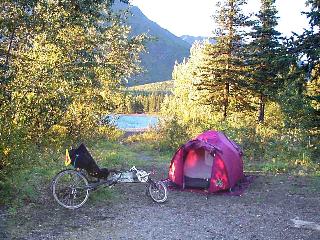 I took a camping trip in early September. It
wasn’t just any camping trip. It was my first camping trip, and it was from my
bicycle. I biked the Kenai Peninsula for seven days camping with my tent in the Forest
Service and State Recreation parks.
I took a camping trip in early September. It
wasn’t just any camping trip. It was my first camping trip, and it was from my
bicycle. I biked the Kenai Peninsula for seven days camping with my tent in the Forest
Service and State Recreation parks.
Why? It was a checkout ride to prepare me for next year’s
vacation. For seven weeks during the summer of 1998, I will participate in a fund raising
ride for the American Lung Association. The ride starts in Seattle, and ends 3,000
miles later in Washington D.C. So I have to be able to ride long distances, day after
day, and stay in a tent and sleeping bag every night. So this was a test to get the
experience of what I might need for the longer ride.
The ride this fall was a little harder in that I had to carry my own
gear and food. The ride next summer will be fully supported. My gear will be transported
to the next evening’s camp, and I will be provided with breakfast and dinner. So
there I was, traveling on my bicycle, pulling a little trailer, and hauling my camping
equipment, clothing and food.
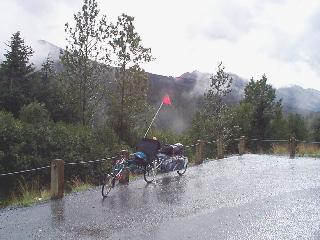 The week before I left, I kept watching the weather. It rained very
hard frequently during the week. When I expressed doubt to my friend Andy, he simply
replied, "No matter what the weather is when you start your ride, you will
experience all types of weather within the week that you are camping." He was
right. It rained as hard as ever on Sunday, when I left, but let up within the first hour.
This was fortunate because I started out riding and wearing rain gear, but I get
overheated easily with rain gear so I was glad to be able to take it off. From that point,
It never rained again for the seven days except at night. What luck! Even though it was
September, the temperature hit the 60’s and 70’s every day and was usually in
the high 40’s at night. The scenery matched the weather. What a great way to end the
summer.
The week before I left, I kept watching the weather. It rained very
hard frequently during the week. When I expressed doubt to my friend Andy, he simply
replied, "No matter what the weather is when you start your ride, you will
experience all types of weather within the week that you are camping." He was
right. It rained as hard as ever on Sunday, when I left, but let up within the first hour.
This was fortunate because I started out riding and wearing rain gear, but I get
overheated easily with rain gear so I was glad to be able to take it off. From that point,
It never rained again for the seven days except at night. What luck! Even though it was
September, the temperature hit the 60’s and 70’s every day and was usually in
the high 40’s at night. The scenery matched the weather. What a great way to end the
summer.
This trip was no less expensive than any weeklong first class vacation.
The reason was simple. Since it was my first camping trip, I needed all the necessary
equipment, tent, sleeping bag, cook-stove. I talked with many friends in the preparation
for this trip, so I made sure that I had one of everything I could possibly need. I also
spent many an hour browsing the aisles of REI. There were so many things that I must have.
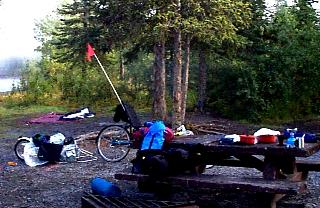 My goal was 70 pounds. This is the weight limit of my gear next
year, and it was also the weight limit of my trailer for the bike. So about a week before
the trip, I weighed all my equipment. Only 54 pounds, I was doing great. But I hadn’t
added my clothing or food. I’ve only been biking for two years. I still don’t
have the ultra lightweight clothing, and I’m not experienced in selecting food for
camping. So…well, I figure that the weight limits must be like speed limits.
Isn’t there a 10-mph grace. Must be a 10-pound grace too. Oh, and at the last minute,
I tossed in a book to read. (Did I tell you that I’m in the computer profession?
Computer books are never thin nor light.) So I’m slightly embarrassed about how much
weight I finally took. When a cop stops you for speeding the rule is to shave your speed
down to within the 10 mph grace. So regardless of how fast I was going, I’ll only
admit to 59 in a 50 mph zone. So I didn’t have more than 79 pounds.
My goal was 70 pounds. This is the weight limit of my gear next
year, and it was also the weight limit of my trailer for the bike. So about a week before
the trip, I weighed all my equipment. Only 54 pounds, I was doing great. But I hadn’t
added my clothing or food. I’ve only been biking for two years. I still don’t
have the ultra lightweight clothing, and I’m not experienced in selecting food for
camping. So…well, I figure that the weight limits must be like speed limits.
Isn’t there a 10-mph grace. Must be a 10-pound grace too. Oh, and at the last minute,
I tossed in a book to read. (Did I tell you that I’m in the computer profession?
Computer books are never thin nor light.) So I’m slightly embarrassed about how much
weight I finally took. When a cop stops you for speeding the rule is to shave your speed
down to within the 10 mph grace. So regardless of how fast I was going, I’ll only
admit to 59 in a 50 mph zone. So I didn’t have more than 79 pounds.
I was well supplied for my trip. I had everything I could possibly
need. I even had a little extra cash with me so I could stop at Gwin’s and get a
big juicy red meat hamburger and fries. Little things like that are luxuries on a
camping trip. I had everything I needed except for enough cash. I hadn’t planned on
the camping fees in the parks. I was short and had to stop at an ATM in Seward to get
extra cash so I could "rough it" all week. Camping in the wilderness of
Alaska is tough!
My ride started about 10 miles north of Summit Lake. My wife drove me
to just south of the road construction near Hope. I didn’t want to ride though the
construction area, nor did I want to ride between Indian and Girdwood, since that road had
very heavy traffic and no shoulder to get out of the traffic. I stayed the first night
near Summit Lake. I rode to Seward the next day and spent the night at Exit Glacier. Then
back to Seward, and the ATM machine. From there I went back up to the Y, and headed for
Kenai. I stayed at Quartz Creek. Then next night found me in Sterling at Moose River. The
last two days of my trip were spent in the Captain Cook Recreations Park north of Kenai. I
ended the trip at my in-law’s house near Nikiski. The trip totaled 250 miles.
As I was coasting downhill into Seward, I thought, this is a long way
down. Maybe I should stop now and camp tonight right on this spot, then I can start back
up from here instead of having to climb all the way out of Seward. But I went all the way
down into Seward. On the way back up out of Seward, the wind was blowing against me. Why
is it that the wind blows against you when you are peddling up-hill? But I made it up
the grade without a problem. I just shifted down and kept the pedals spinning, and very
slowly, but surely, I climbed the hill.
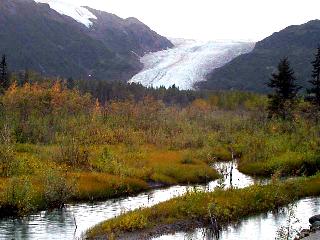 The campgrounds were excellent. They were well maintained, clean and
quiet. They all had drinking water, so the water filter that I had in my camping gear went
unused for the whole trip. I was over-packed on clothing and snacks. I was only short one
thing (cash), and the only thing that I didn’t use was the water filter. The next
time I should do a little better, and get closer to 70 pounds of gear too.
The campgrounds were excellent. They were well maintained, clean and
quiet. They all had drinking water, so the water filter that I had in my camping gear went
unused for the whole trip. I was over-packed on clothing and snacks. I was only short one
thing (cash), and the only thing that I didn’t use was the water filter. The next
time I should do a little better, and get closer to 70 pounds of gear too.
The ride itself was an experience. Like the little caterpillar that
crawled all the way across the road and into my path. He had crawled 40-50 feet across the
road and had only had 6 inches left to get off the road before I came along . . . Hey,
did you know that Moose pass has a bike path! It sure feels a lot safer being on the
bike path than on the side of the road, especially when there is no shoulder, and when
there’s also a guardrail.
While you’re riding along, you have lots of time to think. I rode
for about 7 hours including rest stops. I averaged 9.5 mph while moving and about 7.5 mph
if I include rest stops. I thought that I could devise a test. Take two human controlled
projectiles, the object is to have them travel toward each other at a speed of over 100
mph. relative to each other. Have them pass within a couple of feet of each other without
touching. Now, to make this test harder, let’s make the path crooked, going around
many blind corners and over hills. Now, if that’s not enough, lets put a surprise
obstacle (me) in the path of one of the vehicles. If either of these vehicles or I slip
up, I’m toast. Fortunately, everyone passed this test again, again, again, again
and again.
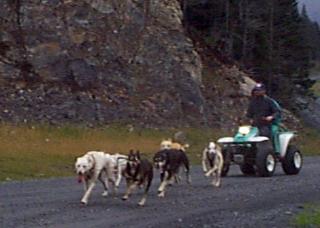 Riding on the highway when there is an ample shoulder is great. At
times the paved shoulders were eight feet wide. Even when they were only 3-4 feet wide I
felt fairly comfortable. But, when there was no shoulder, I was force to ride in the lane
with the traffic. While I stayed as close to the edge as I could, my bike took up about
two feet out of the lane of traffic. All the drivers were wonderful. The only problem that
I had was a few large trucks going fast, and while they gave me ample clearance, the wind
from the trucks buffeted me mightily and I had to hold tight and not let the winds jerk my
bike back and forth too much. To my surprise, people in motor-homes were the most
courteous. They would often slow down and wait to pass me when conditions were clear. No
other vehicles did this. I suspect that people in cars or trucks, knew the limits of their
vehicles better while people in motor-homes did not know their limits as well and played
it safe. I thank them for their caution.
Riding on the highway when there is an ample shoulder is great. At
times the paved shoulders were eight feet wide. Even when they were only 3-4 feet wide I
felt fairly comfortable. But, when there was no shoulder, I was force to ride in the lane
with the traffic. While I stayed as close to the edge as I could, my bike took up about
two feet out of the lane of traffic. All the drivers were wonderful. The only problem that
I had was a few large trucks going fast, and while they gave me ample clearance, the wind
from the trucks buffeted me mightily and I had to hold tight and not let the winds jerk my
bike back and forth too much. To my surprise, people in motor-homes were the most
courteous. They would often slow down and wait to pass me when conditions were clear. No
other vehicles did this. I suspect that people in cars or trucks, knew the limits of their
vehicles better while people in motor-homes did not know their limits as well and played
it safe. I thank them for their caution.
I am fortunate that the only digital gestures that I got during the
ride were thumbs up.
When the road gets narrower, they put up guardrails. From my standpoint
on the bike, this made the road even narrower. My ability to stray from my given path was
now limited on my right hand side. If I brushed up against the rail, I would surely lose
control and fall over. I had already experienced this loss of control on the Coastal trail
when I got too close to a retaining wall along the path. If that happened in traffic, I
would fall over and be done for.
As I rode along beside the guardrail, I could only look at the rail and
think "Schmear" That’s the creamy stuff they spread on bagels, only
this schmear wouldn’t be made from honey and walnuts. After miles of guardrail, I
began to notice that often, many great lengths of the guardrail had been scraped by
vehicles passing very closely. I presumed this was primarily from snowplows. The effect
was that the rail which normally had its edges curved back away from the road, now had the
edge distorted and facing straight up. As I rode along beside the guardrail, I could look
straight down upon this edge and thought "razor blades". So when I reached the
bike path at Moose Pass, I was greatly relieved. Riding on the bike path is a lot more
relaxing than riding on curves, no shoulder, and against the guard rail. I thank the Moose
Passian’s, Moose Passers or whatever you call yourselves. That bike-path was a
welcome break. I’ll bet that caterpillar wished he had a caterpillar path!
I ride a recumbent bike. This bike is one that you sit down in and your
feet extend out to the pedals in front of you. The handlebars are below the seat. This is
very comfortable. You sit in a real seat, not a narrow hard saddle. Your hands are in a
relaxed position at your side, holding onto the handlebars below your seat. On a normal
bike, you put pressure on your hands as you lean into the handlebars. This causes your
hands to get numb. I don’t have this problem on a recumbent bike. But, because the
bike is lower, it is less visible to other people. I put a flag on my bike to alert
drivers of my presence. I also have a large day-glow florescent triangle (slow vehicle
sign) on the back of my bike. Anything to make me more visible is a plus.
 As I was riding from Seward toward Kenai, I reached Tern Lake at the
"Y". Riding along the lake I saw a Kayaker on the lake. What a great place, this
Alaska, the mountains and lakes, riding along in the wilderness on a sunny and warm
afternoon. Very enjoyable indeed.
As I was riding from Seward toward Kenai, I reached Tern Lake at the
"Y". Riding along the lake I saw a Kayaker on the lake. What a great place, this
Alaska, the mountains and lakes, riding along in the wilderness on a sunny and warm
afternoon. Very enjoyable indeed.
I stopped at the picnic area at Tern Lake for a rest. The kayaker now
had come back and put her kayak on her car, than came over and chatted with me for a
while. That’s one nice thing about a recumbent bike, it’s a great
conversation starter. Anyway, the kayaker told me that she could see me from across
the lake and that my flag and day-glow triangle were doing their job, making me quite
noticeable. Another day without being run down by a kayak. Anything to make me more
visible is worth it.
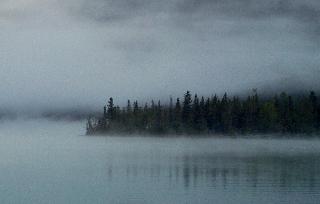 After riding for hours along a stretch of highway with no shoulders,
you begin to pray. You pray that you don’t lose control, that you can stay very close
to the edge of the road, but not too close. You pray that you don’t swerve in front
of a vehicle because you can’t keep a bicycle going without an occasional swerve. You
pray that the drivers of the vehicles always see you, and that they, every one of them,
give you enough room. One mistake by myself or anyone else would be dangerous to me. There
is little that I could do, to enhance my safety while riding along a shoulder-less stretch
of highway, except avoid shoulder-less highways. In the future, I will ride where the
roads are safer for me, ‘cause I’m sure, I’m setting myself up to become
road-kill.
After riding for hours along a stretch of highway with no shoulders,
you begin to pray. You pray that you don’t lose control, that you can stay very close
to the edge of the road, but not too close. You pray that you don’t swerve in front
of a vehicle because you can’t keep a bicycle going without an occasional swerve. You
pray that the drivers of the vehicles always see you, and that they, every one of them,
give you enough room. One mistake by myself or anyone else would be dangerous to me. There
is little that I could do, to enhance my safety while riding along a shoulder-less stretch
of highway, except avoid shoulder-less highways. In the future, I will ride where the
roads are safer for me, ‘cause I’m sure, I’m setting myself up to become
road-kill.
I’ll bet that caterpillar was praying
too. He had to be, to make it 99% of the way across the road. I stopped and let him pass.
All pictures and text (c) 1998 by Bill
Peterson, Anchorage, Alaska.
Previous: Home: Next: